Vibe Coding vs. Robotics Classes: Which Is Better for Creativity and STEM Growth?
- 3 February 2026
- Published by tutree
- STEM.org Accredited™ Partner

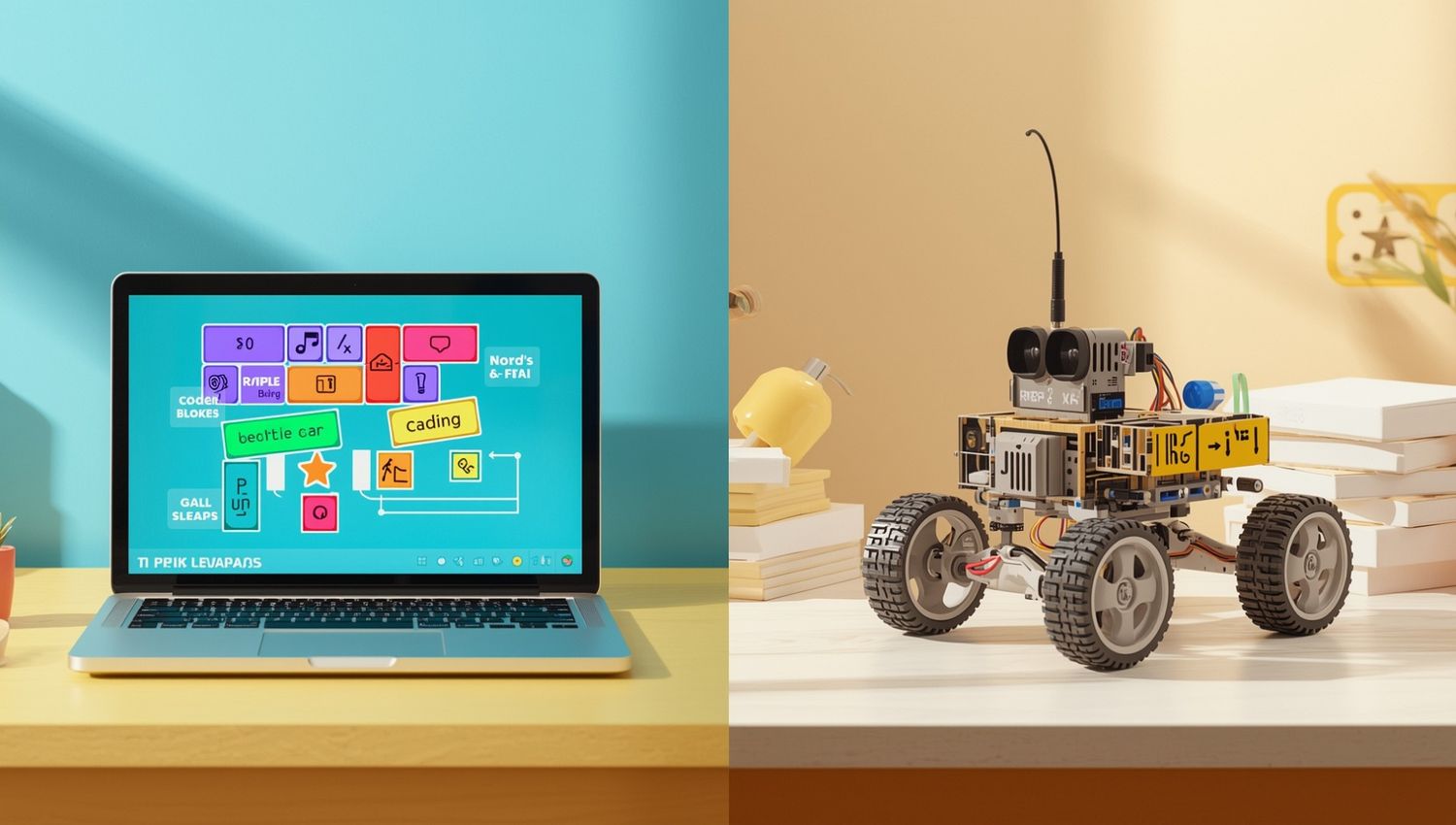
As a parent, you likely hear about STEM education everywhere you turn. Schools emphasize it, after-school programs promote it, and the news constantly highlights the growing demand for tech skills. You know you want to give your child a strong head start, but the options can feel overwhelming. Two of the most popular pathways for young learners are vibe coding and robotics.
Both options look exciting on the surface. One involves creating colorful digital worlds on a screen, while the other involves snapping together gears and motors to build moving machines. It raises an important question for families. Which one is actually better for creativity and long-term STEM growth?
The answer often depends on your child’s specific interests and how they like to learn. Understanding the differences between these two powerful learning tools will help you make the right choice for your family.
What Is Vibe Coding?
Vibe coding is a modern approach to computer programming that emphasizes creativity, self-expression, and fun over rigid syntax. Instead of staring at lines of complex text, students use visual tools and interactive platforms to bring their ideas to life immediately.
This method often uses "block-based" coding. Children drag and drop colorful puzzle pieces that represent commands. They can create their own video games, design interactive stories, or build animations. Platforms like Scratch or Roblox Studio are great examples of this. The goal is to make the logic of coding feel intuitive and rewarding.
Because vibe coding often happens in online coding classes for kids, it is highly accessible. Students can learn from the comfort of their own rooms. They focus on the "vibe" or the feeling of the final product, which keeps them motivated to learn the harder technical concepts underneath.
What Are Robotics Classes?
Robotics classes take a different approach. They move the learning experience off the screen and into the physical world. In these classes, students work with hardware. They handle sensors, motors, gears, and structural pieces to build a machine.
Once the robot is built, the coding comes in. Students must write a program to tell the robot what to do. They might code a vehicle to follow a black line on the floor or build a robotic arm that picks up a ball.
Robotics is a blend of mechanical engineering, electronics, and computer science. It requires students to think about physical constraints. A piece of code might be perfect, but if the robot is too heavy or the battery is low, it will not work. This adds a layer of real-world complexity to the learning process.
Creativity Benefits of Vibe Coding
Many people think of coding as purely logical, but vibe coding is actually a deeply creative pursuit. It acts as a blank canvas where the only limit is the child's imagination.
-
Limitless Exploration: In a digital environment, students never run out of building materials. They can create a game with one level or one hundred levels without needing to buy more parts.
-
Artistic Expression: Vibe coding allows kids to design characters, compose music, and draw backgrounds. It blends art with technology seamlessly.
-
Instant Feedback: When a child changes a line of code, they see the result instantly. This fast feedback loop encourages them to experiment and try wild new ideas without fear of breaking anything expensive.
-
Storytelling: Many vibe coding projects focus on narrative. Kids learn to structure a story with a beginning, middle, and end, using code to trigger plot twists and dialogue.
Creativity Benefits of Robotics Classes
Creativity in robotics looks a little different. It is known as "constraint-based creativity." Because students have to work with physical laws and limited parts, they have to be inventive to solve problems.
-
Design Thinking: Students must sketch and plan their builds. They have to imagine how a 2D idea will look and function in 3D space.
-
Physical Problem Solving: If a robot keeps falling over, the student has to get creative with weight distribution and structural support.
-
Engineering Intuition: Kids learn to see everyday objects differently. They start to understand how hinges, levers, and wheels work together to create motion.
-
Collaborative Innovation: Robotics is often done in teams. This pushes children to brainstorm together, combine their best ideas, and negotiate creative solutions to a shared challenge.
STEM Growth With Vibe Coding
While it is incredibly fun, vibe coding is also serious academic work. It lays a massive foundation for future success in science, technology, engineering, and math.
The core benefit is logic. To make a character jump when the spacebar is pressed, a child must understand cause and effect. They learn about sequencing, which means putting instructions in the exact right order. They also grasp the concept of algorithms, which are just step-by-step solutions to problems.
Perhaps the most valuable skill built here is resilience through debugging. When coding for kids at home, things rarely work perfectly the first time. A game might glitch, or a character might walk through a wall. The child has to hunt through their logic to find the error. This builds a "growth mindset" where mistakes are seen as puzzles to be solved rather than failures.
STEM Growth With Robotics Classes
Robotics offers a unique entry point into STEM because it introduces physics. A student can read about gravity in a textbook, but watching their robot struggle to climb a ramp teaches them about torque and friction in a way they will never forget.
-
Systems Thinking: Robotics teaches kids how hardware and software interact. They learn that a machine is a system of connected parts that rely on each other.
-
Sensor Data: Students learn how to interpret data from the real world. They use distance sensors or light sensors to trigger actions, which is the basis of automation and artificial intelligence.
-
Mechanical Reasoning: By assembling gears and pulleys, children develop a strong intuitive sense of mechanics. This is a foundational skill for future engineers and architects.
Choosing What Is Best for Your Child
So, which path should you choose? There is no single right answer, but you can look at your child’s personality for clues.
If your child loves drawing, writing stories, playing video games, or thrives on immediate results, vibe coding is likely the best starting point. It allows them to express themselves quickly and builds confidence in their ability to control technology.
If your child loves Legos, taking things apart, or is fascinated by how machines work, robotics might be the better fit. It satisfies the urge to build with their hands and helps them understand the physical world.
However, these two subjects support each other. Live coding classes for kids can provide the logical foundation needed to excel in robotics later on. Many families find that starting with coding helps students understand the "brain" of the robot before they try to build the body.
How Tutree Supports STEM Growth
At Tutree, we believe that personalized attention makes all the difference in learning difficult subjects. Whether your child is interested in game design or the logic needed for robotics, having a dedicated mentor changes the experience.
Our platform connects students with coding tutors for kids who are experts at breaking down complex concepts. We offer live, one-on-one sessions via Zoom. This means your child gets real-time feedback and encouragement. Our tutors include high-performing students who know how to make learning relatable and fun.
We focus on building confidence. By mastering the fundamentals of logic and problem-solving with a tutor, your child gains skills that apply to vibe coding, robotics, and their regular school math classes. It is about giving them the tools to learn anything they set their minds to.
Conclusion
Both vibe coding and robotics offer incredible benefits for your child’s development. Vibe coding excels at fostering digital creativity, logical sequencing, and storytelling. Robotics shines in teaching engineering design, physical physics, and mechanical problem-solving.
The best choice often comes down to what excites your child the most right now. The goal is to foster a love for learning and discovery. Whether they are building a virtual world or a physical machine, they are developing the critical thinking skills that will serve them for a lifetime.
Ready to spark your child's creativity? Explore our personalized classes and find the perfect match for your learner today.
Related Articles
AI coding agents are changing how software is built, but what does this mean for students learning to code? Explore how coding education may evolve in 2027, the role of AI agents, and why programming fundamentals, problem-solving, creativity, and responsible AI use will remain essential for the next generation of builders.
AI tools like ChatGPT and GitHub Copilot are changing how code gets written — but they haven't made coding obsolete. In fact, coding skills are more valuable than ever. This guide helps parents understand why children should still learn programming, what skills truly matter in the AI era, and how starting early gives kids a lifelong advantage in any career they choose.
Vibe coding strengthens core math skills by reinforcing logic, patterns, and structured problem solving through hands-on programming. By applying math concepts in real projects, students build confidence, improve reasoning, and develop academic skills that support long-term success across subjects.
