Is Coding Still Worth Learning in the AI Era?
- 25 June 2026
- Published by tutree
- STEM.org Accredited™ Partner

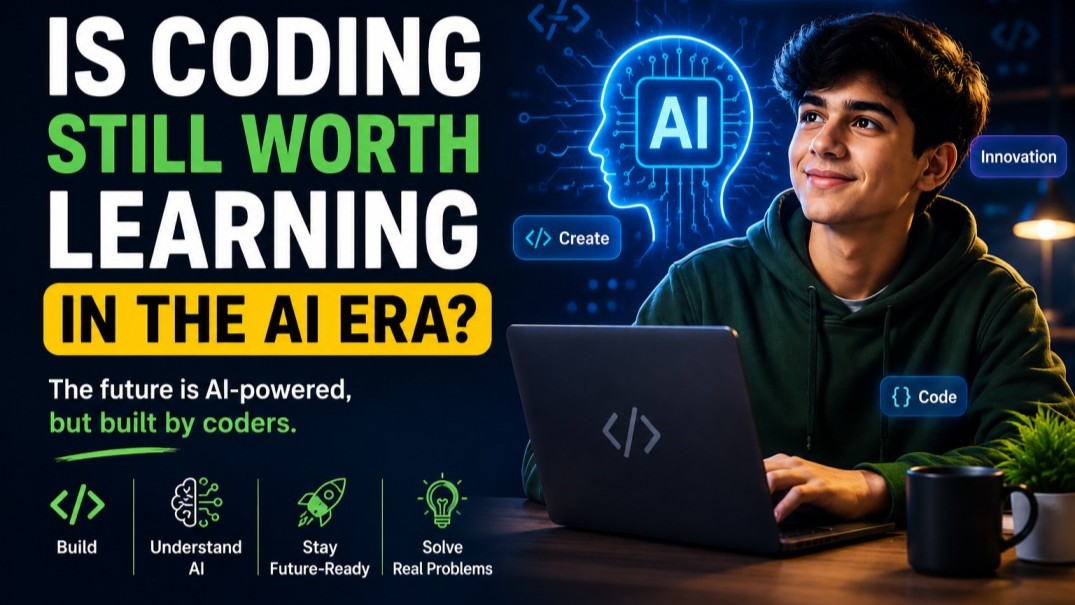
Is Coding Still Worth Learning in the AI Era? What Every Parent Needs to Know
Every week, a new headline claims that AI will replace programmers. ChatGPT writes essays, GitHub Copilot generates whole blocks of code, and Cursor builds apps in minutes. So if you're a parent wondering whether to enroll your child in coding classes, it's completely fair to ask: Is coding still worth learning in the AI era?
The short answer is a confident yes — but the why has changed. And understanding that "why" could be one of the most important decisions you make for your child's future.
Let's break it all down clearly, without the tech jargon.
What AI Coding Tools Actually Do (And What They Can't)
Tools like ChatGPT, GitHub Copilot, and Cursor AI are genuinely impressive. GitHub Copilot, for example, now generates an average of 46% of all code written by its users, with Java developers seeing up to 61% of their code auto-generated by AI. Between 2023 and 2025, AI-assisted coding grew by over 400%. That's not a small shift — it's a revolution.
But here's what those tools cannot do on their own:
- Understand the actual problem that needs solving
- Design how a system should be built from scratch
- Decide whether a solution is safe, ethical, or scalable
- Test whether the output makes real-world sense
- Fix errors when the AI-generated code breaks in production
AI tools are pattern-prediction engines — they guess the next most statistically probable line of code. They don't actually understand logic, context, or user needs. Think of AI as a power drill: incredibly useful, but only in the hands of someone who knows what they're building. A child who understands coding can direct AI. A child who doesn't is just clicking buttons and hoping for the best.
Will AI Replace Programmers? Here's the Real Answer
This is the question on every parent's mind, and the honest answer is: no — but the job is evolving.
The U.S. Bureau of Labor Statistics projects employment for software developers, quality assurance analysts, and testers to grow by 15% — faster than the average for all occupations. Even as AI tools flood the market, companies still desperately need people who understand software architecture, debugging, system design, cybersecurity, databases, and user.
A 2025 Stack Overflow survey found that over 78% of developers use AI-assisted tools daily — but employers still specifically value those who understand data structures, algorithms, and debugging, because when AI fails, a human needs to step in and fix it.
What's changing is the role of a coder. The job is shifting from "person who types code" to "person who thinks like an architect." As one developer put it: "AI didn't kill coding — it evolved it. Just like a calculator didn't kill math, and Photoshop didn't kill art."
The coders of tomorrow won't be replaced by AI. They'll be the ones using AI to do things that used to take entire teams.
Is Coding Still Worth Learning in the AI Era? For Kids, More Than Ever
Here's something that might surprise you: the benefits of learning to code for children go far beyond job prep. Research consistently shows that coding shapes how kids think — and that has value in every career, AI-powered world or not.
A peer-reviewed study found that children who learned to code showed significant improvements in computational thinking, algorithmic reasoning, and pattern recognition compared to those who didn't. A separate meta-analysis of 19 studies covering 1,523 participants found that coding instruction significantly improves problem-solving (effect size d = 0.89), along with planning, inhibition, and working memory. These aren't just "tech skills." These are life skills.
A randomized controlled trial published in PubMed confirmed that learning to code selectively improves computational thinking skills in children — independent of other factors. In other words, when your child learns to code, they're not just learning to write Python or Scratch blocks. They're rewiring their brain to approach problems more systematically.
The 7 Biggest Reasons Kids Should Learn Coding Today
Here's why coding for kids isn't just still relevant — it's one of the smartest investments you can make in your child's future:
- Critical thinking development — Coding teaches children to break big problems into small, manageable steps, a skill that applies to math, science, writing, and life
- Creativity with structure — Kids build games, apps, and animations, learning to express imagination through logical systems
- Resilience and persistence — Debugging code means learning to fail, analyze, and try again — one of the most underrated skills in any field
- AI literacy — A child who understands code can evaluate, guide, and correct AI-generated output, rather than being dependent on it
- Future-proof career options — Tech skills translate to medicine, finance, design, engineering, data science, and virtually every industry powered by software
- Higher earning potential — Software development remains one of the highest-paying entry-level careers, with strong job growth projected through the decade
- Entrepreneurial power — Coding gives kids the ability to build their own ideas into real products, rather than waiting for someone else to do it
Can Kids Just Rely on AI to Code for Them?
This is a fair question, and many parents are genuinely asking it. If ChatGPT can write code, why does a child need to learn?
The answer is what educators call the "80/20 problem." No-code and AI tools can get you to 80% of a solution — fast. But the last 20% that makes a product actually work, stay secure, scale to users, and stand out? That requires real technical understanding.
Here's a practical example: Imagine your child wants to build a school project app. They use ChatGPT to generate code. The AI produces something that looks right. But it has a security flaw that exposes user data, or crashes when more than 10 people use it. Without coding knowledge, your child has no idea how to identify or fix the problem. With even basic coding skills, they can spot the issue, ask the AI better questions, and actually ship something that works.
AI also makes mistakes — often confidently. It misunderstands problems, generates code that breaks in real-world conditions, and sometimes creates security vulnerabilities. Kids who understand programming fundamentals can be supervisors of AI, not victims of it.
What Coding Skills Actually Matter Now?
The focus of coding education is shifting — and this is actually great news for kids learning today. It's less about memorizing syntax (which AI handles fine) and more about developing the thinking skills that AI still can't replicate.
The most valuable coding skills for children to develop include:
- Logical problem-solving — Understanding how to decompose and solve a problem step by step
- System design thinking — Knowing how different parts of a program connect and interact
- Debugging mindset — Learning to trace errors, test hypotheses, and fix broken code
- Prompt engineering — Knowing how to give AI clear, precise instructions to get useful results
- Core language foundations — Scratch and Code.org for beginners (ages 6–10), then Python, JavaScript, or Java as they grow
- Project-based building — Creating real apps, games, or websites, not just completing exercises
The best coding education programs don't just teach syntax — they teach children how to think like engineers. That mindset is what remains valuable regardless of how AI tools evolve.
What Age Should Kids Start Learning to Code?
Earlier than most parents think. Research shows that children as young as 4–6 years old benefit measurably from structured coding activities. Platforms like ScratchJr and Code.org use visual, game-like interfaces that make coding accessible and fun for young children — no reading or typing required.
Here's a simple age-based roadmap:
What Age Should Kids Start Learning to Code?
Earlier than most parents think. Research shows that children as young as 4–6 years old benefit measurably from structured coding activities. The good news is that coding education today is designed to meet kids exactly where they are — and grow with them.
Ages 6–8: Building the Foundation
At this stage, it's all about making coding feel like play. Young learners start with visual block coding, where they drag and drop colorful puzzle pieces to create sequences and simple loops — no typing required. Tools like Scratch Jr and Code.org are perfect here, turning early logic skills into interactive stories and mini-games that kids actually want to keep playing.
Ages 9–11: Leveling Up the Fun
As kids get more comfortable, they're ready to take on bigger creative challenges. Intermediate block coding opens the door to game design and digital storytelling, giving children real projects they can share with friends and family. Platforms like Scratch and Tynker let kids build their own games, animations, and interactive worlds while quietly developing serious problem-solving skills behind the scenes.
Ages 12–14: Making the Jump to Real Code
This is where the training wheels come off — and it's incredibly exciting. Kids transition from block-based coding to actual text-based programming languages like Python, one of the most beginner-friendly and widely used languages in the world. They also start exploring web fundamentals with HTML and CSS, learning how websites are actually built. By the end of this stage, many kids have already created their first real programs and web pages.
Ages 15–17: Building Like a Developer
Teenagers in this range are ready to think and build like junior developers. The focus shifts to full project development using JavaScript, building web and mobile apps, and learning how to work with APIs — the connectors that power modern software. Many students at this stage also begin exploring AI concepts and how to integrate AI tools into real projects, setting them up for college, internships, and careers with a serious head start.
Starting early means more time to build the computational thinking habits that compound over years. A 10-year-old who spends three years learning to code is a 13-year-old who thinks like a junior developer — before high school has even started.
Coding + AI: The Most Powerful Combination
Here's the exciting part for today's learners: kids who grow up knowing both coding fundamentals and how to use AI tools will be in an extraordinary position.
AI is not eliminating coding careers — it's creating entirely new ones. Companies now need people who understand AI integration, automation, machine learning basics, prompt engineering, and data handling. Most of these roles still depend heavily on coding knowledge. The students who thrive won't be the ones who only know how to use AI, nor the ones who ignore it — they'll be the ones who can do both.
Think of it this way: AI is the most powerful tool in the history of software development. And just like every powerful tool in history — from electricity to the internet — the people who understand how it works will lead, while those who don't will follow.
How Tutree Prepares Kids for the AI Era
At Tutree, we design coding education specifically with this future in mind. Our curriculum for children aged 6–17 isn't about memorizing commands — it's about building the problem-solving instincts, creative confidence, and technical fluency that let kids thrive whether they're coding solo, working with AI, or doing both.
From beginner Scratch courses for young learners to Python, JavaScript, and project-based development for teens, every Tutree class is built to grow with your child. Our instructors understand not just how to code, but how to teach it in ways that stick — for the long term.
Because in a world where AI can write code, what sets your child apart isn't whether they learned to type semicolons. It's whether they know what to build, why to build it, and how to make it work.
Final Thoughts: Don't Wait to Future-Proof Your Child
Is coding still worth learning in the AI era? Absolutely — and the argument for it has never been stronger. The rise of AI tools doesn't make coding obsolete; it makes understanding coding more valuable than ever. The children learning to code today are building the instincts, problem-solving habits, and technical literacy that will define the next generation of innovators, entrepreneurs, and leaders.
The question isn't whether your child needs to learn coding. It's whether they'll learn it now — or try to catch up later.
Ready to start your child's coding journey? Explore Tutree's beginner-to-advanced coding classes for kids ages 6–17 at tutree. Whether they want to build games, apps, websites, or the next big thing powered by AI — it all starts with learning to code.
Related Articles
AI coding agents are changing how software is built, but what does this mean for students learning to code? Explore how coding education may evolve in 2027, the role of AI agents, and why programming fundamentals, problem-solving, creativity, and responsible AI use will remain essential for the next generation of builders.

Vibe coding strengthens core math skills by reinforcing logic, patterns, and structured problem solving through hands-on programming. By applying math concepts in real projects, students build confidence, improve reasoning, and develop academic skills that support long-term success across subjects.

Vibe coding helps students develop problem-solving, creativity, and confidence through hands-on, engaging coding experiences. By starting early, students gain future-ready skills that apply across industries like technology, healthcare, finance, and business, preparing them for high-paying careers in a rapidly evolving job market.
