Math Anxiety in Kids: Signs Every Parent Should Watch For
- 19 December 2025
- Published by tutree
- STEM.org Accredited™ Partner

Introduction
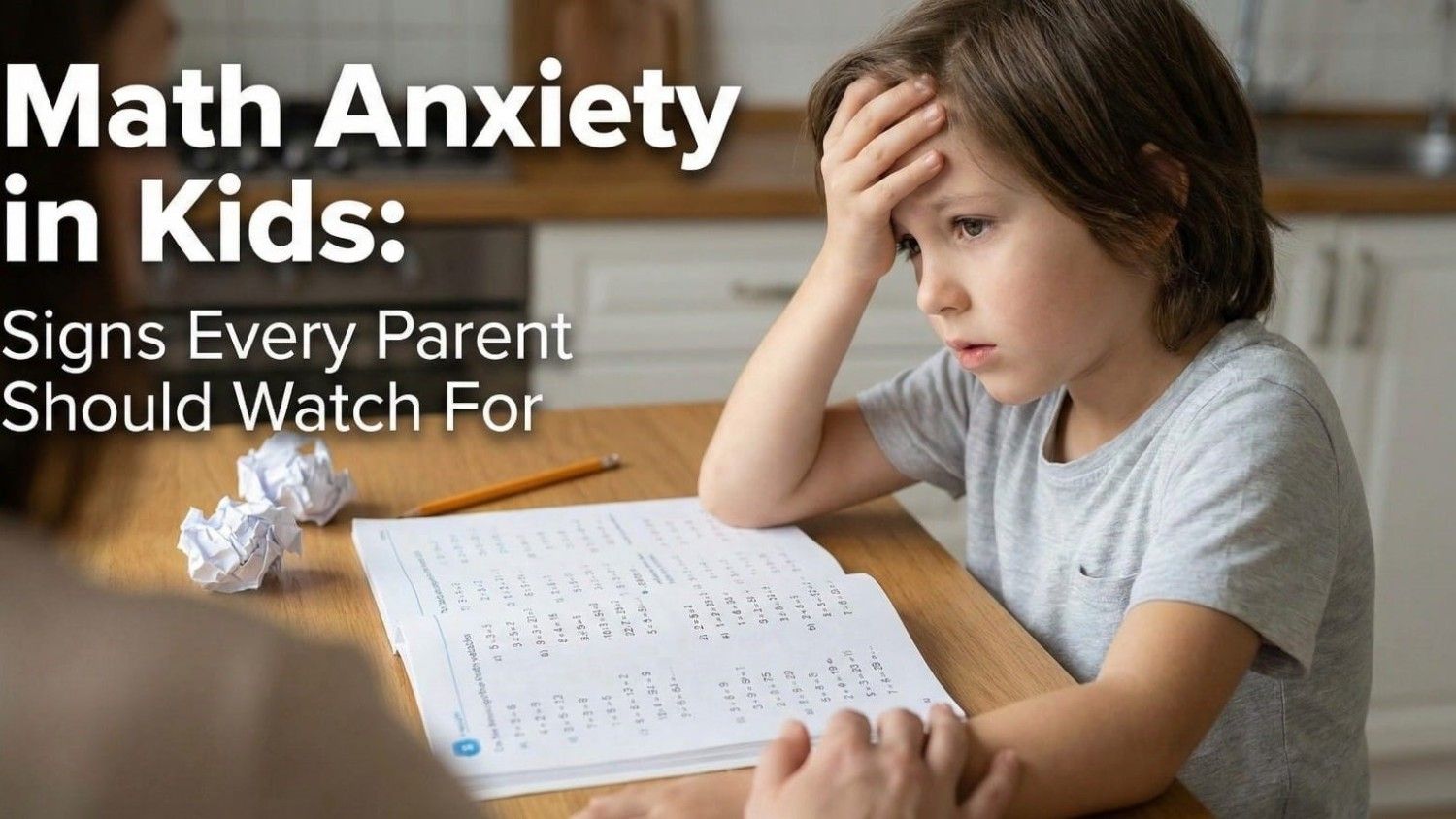
Your daughter sits at the kitchen table, staring at her math homework. Her pencil hovers over the page, but nothing happens. Five minutes pass. Then ten. You notice her eyes welling up with tears, and when you gently ask what's wrong, she whispers, "I can't do this. I'm just stupid at math."
If this scene feels painfully familiar, you're not alone — and more importantly, your child isn't struggling because they're "bad at math." What you're witnessing might be math anxiety, a very real emotional and psychological response that affects millions of children across the United States.
Math anxiety isn't about intelligence or capability. It's about fear. It's the knot in your child's stomach before a timed test, the panic that makes them forget everything they knew just moments before, and the voice in their head saying they'll never understand numbers. Research shows that 64% of Americans experience some form of math anxiety, with middle school being the most common time for its onset. But here's what many parents don't realize: math anxiety often begins much earlier, sometimes as young as first grade, quietly building until it becomes an undeniable barrier to learning.
The challenging part for parents is that math anxiety doesn't always look like crying or panic attacks. Sometimes it looks like avoidance — homework that mysteriously gets "forgotten," sudden stomachaches during math class, or a child who can explain a concept perfectly at home but freezes completely on test day. These aren't signs of laziness or defiance. They're red flags that your child's brain has learned to associate math with stress, creating a cycle that becomes harder to break the longer it continues.
Here's the good news: math anxiety is not permanent. With the right support, understanding, and approach, children can rebuild their relationship with math. The first step is recognizing the signs early, understanding what's really happening, and knowing that seeking help isn't admitting defeat — it's giving your child the chance to feel confident and capable again.
This comprehensive guide will walk you through everything you need to know about math anxiety in kids: what it is, why it's more common today than ever before, the specific signs to watch for, and most importantly, what you can do to help. Whether your child is in elementary school just beginning to show resistance to math, or in middle school already convinced they "hate math," understanding math anxiety is the foundation for helping them move forward.
What Is Math Anxiety?
Math anxiety is more than simply disliking math or finding it challenging. It's a genuine emotional and psychological response characterized by feelings of tension, fear, and apprehension specifically related to mathematics. When a child experiences math anxiety, their brain doesn't just think "this is hard" — it triggers a stress response similar to what we might feel in genuinely threatening situations.
Think of it this way: when your child sits down to do math homework or takes a math test, their body might respond as if they're facing actual danger. Their heart rate increases, their palms sweat, their stomach churns, and most problematically, their working memory — the mental space needed to solve problems — becomes compromised by worry and fear. This creates a frustrating paradox: the anxiety itself makes math harder, which then reinforces the belief that "I'm bad at math," which creates more anxiety.
Math anxiety differs fundamentally from simply not enjoying math. Plenty of children find math less interesting than reading or art, but they can still complete their work without emotional distress. A child with math anxiety, however, experiences genuine psychological symptoms that interfere with their ability to perform, even when they understand the concepts. They might know how to solve a problem when explaining it verbally to you at home, but when faced with a worksheet or test, their mind goes blank.
The anxiety manifests in three interconnected ways. First, there's the emotional component: feelings of dread, helplessness, or panic when encountering math. Second, there's the cognitive component: intrusive worried thoughts like "I'll never get this" or "everyone else understands except me" that occupy mental space needed for problem-solving. Third, there's the physical component: tangible bodily responses including headaches, nausea, rapid heartbeat, or muscle tension.
What makes math anxiety particularly insidious is that it creates a vicious cycle. Anxiety impairs performance, poor performance confirms the child's belief that they're "not a math person," and this belief intensifies the anxiety for next time. Research has consistently shown that children's math anxiety is negatively related to their math achievement, putting their mathematical learning at genuine risk. The longer this cycle continues, the more deeply entrenched it becomes, affecting not just current math performance but potentially future academic and career choices.
It's crucial for parents to understand that math anxiety is not a reflection of their child's intelligence or potential. Bright, capable children experience math anxiety at similar rates to their peers. The anxiety is a learned response, often developing from specific experiences or environmental factors, which means it can also be unlearned with appropriate support and intervention.
Why Math Anxiety Is More Common Today
If it feels like math anxiety is everywhere these days, you're not imagining it. Recent studies confirm that math anxiety levels among students have been increasing over recent decades, with teachers now identifying it as the single biggest obstacle to learning mathematics. Understanding why this is happening can help parents recognize that their child's struggle is part of a broader pattern, not an individual failing.
One significant factor is the increasing academic pressure children face from younger ages. Today's elementary school math curriculum covers content that previous generations didn't encounter until middle school. Kindergarteners are expected to understand concepts that were once reserved for first or second grade. While raising standards can be positive, it also means children are encountering complex mathematical ideas before they're developmentally ready, creating early experiences of confusion and frustration that can seed anxiety.
The prevalence of timed testing has also contributed substantially to math anxiety. Many schools use timed math fact tests, particularly for multiplication tables, as a way to build fluency. However, research shows that the pressure of racing against a clock can trigger anxiety responses in children who might otherwise perform well. When a child's brain is in stress mode, their working memory capacity decreases, making it harder to recall facts they actually know. This creates a terrible irony: the timed test designed to improve fluency actually impairs performance in anxious children, making them appear less competent than they truly are.
Modern classrooms also face a structural challenge: the one-size-fits-all instructional model. With 25 to 30 students in a typical classroom, even the most dedicated teacher cannot provide individualized pacing and support to every child. Some students need more time to grasp concepts, others need different explanations, and many need the safety to ask questions without fear of judgment. When children feel rushed, confused, or afraid to reveal their lack of understanding in front of peers, anxiety takes root.
The COVID-19 pandemic created unprecedented learning disruptions that exacerbated existing math anxiety and created new cases. Remote learning worked well for some students but was devastating for others, particularly in mathematics where hands-on support and immediate feedback are crucial. Many children missed foundational concepts during pandemic-era schooling, creating gaps that make current grade-level work feel impossibly difficult. The research shows this has disproportionately affected girls' math attainment, with factors including greater anxiety and stress levels, less confidence in math abilities, and less parental support compared to other subjects.
Another modern contributor is comparison culture, amplified by social media and competitive academic environments. Children today are acutely aware of how they measure up against peers, not just in their classroom but often across entire schools or districts. Seeing other students grasp concepts quickly or earn higher scores can make struggling learners feel fundamentally inadequate. This constant comparison feeds the narrative that some people are "math people" and others simply aren't — a fixed mindset that intensifies anxiety.
Recent research has also revealed an intergenerational transmission pattern. Studies show that parents' math anxiety can negatively impact their children's early numeracy skills and mathematical development over time. When parents who feel anxious about math try to help with homework or communicate — even unintentionally — that math is difficult or scary, children absorb those attitudes. One researcher noted that teachers frequently hear children claim math anxiety has been "passed down through the generations, like some baleful family legacy".
It's important to emphasize that recognizing these systemic factors doesn't mean blaming schools or teachers, who are working within challenging constraints. Rather, understanding the broader landscape helps parents appreciate that their child's math anxiety is a response to real environmental pressures, not a character flaw or intellectual limitation.
Signs of Math Anxiety Every Parent Should Watch For
Recognizing math anxiety early is one of the most important things you can do as a parent. The challenge is that anxiety doesn't always announce itself clearly. Some children cry or panic, but many others show subtler signs that are easy to miss or misinterpret. Here are the key indicators across emotional, behavioral, physical, and academic categories.
Emotional Signs
The emotional symptoms of math anxiety often appear as disproportionate responses to mathematical tasks. You might notice your child crying or becoming visibly upset when faced with math homework, even if the problems seem manageable. These tears aren't manipulation or overreaction — they're genuine expressions of overwhelming stress.
Listen carefully to your child's self-talk around math. Phrases like "I'm stupid at math," "I'll never understand this," "my brain doesn't work for numbers," or "everyone else gets it except me" are red flags. This negative internal dialogue reflects hopelessness and a fixed belief that mathematical ability is something they simply lack. When children label themselves this way, they're not just expressing frustration with a specific problem — they're declaring a fundamental identity that closes the door to improvement.
Panic is another emotional indicator. Some children experience acute anxiety attacks when faced with math tests or challenging problems — their breathing becomes rapid, they feel overwhelmed, and they may freeze completely. Others experience a lower-level but constant dread, visible in their facial expressions and body language whenever math time approaches. Even children who don't cry might show their stress through facial tension, lip-biting, or a visible shift in mood when transitioning to math activities.
Behavioral Signs
Math anxiety often manifests most clearly through avoidance behaviors. Does your child suddenly need to use the bathroom the moment math homework begins? Do they sharpen pencils repeatedly, organize their desk, or find numerous other tasks that delay actually starting their math work ? These aren't signs of defiance or procrastination in the traditional sense — they're anxiety-driven avoidance tactics.
Pay attention to homework patterns. Math homework that consistently disappears, gets "forgotten," or is completed only after significant struggle and resistance may indicate anxiety rather than disorganization. Some children will complete homework for every subject except math, or they'll leave math for last and then claim they're too tired or have run out of time.
Another behavioral red flag is immediate shutdown. When your child looks at a math problem and instantly says "I don't know" without attempting any problem-solving, it often signals anxiety rather than genuine confusion. Their brain is so overwhelmed by fear that it cannot engage with the task at all. Similarly, children who need constant reassurance — asking "Is this right? Is this right?" after every step — are displaying anxiety-driven doubt in their own thinking.
Watch for unusual perfectionism or excessive caution specifically around math. Some anxious children, particularly girls, become overly focused on avoiding mistakes, which paradoxically makes them more likely to make errors and less willing to take the intellectual risks necessary for learning. They might erase repeatedly, refuse to write anything until they're certain it's correct, or abandon problems entirely rather than risk being wrong.
Physical Signs
The mind-body connection means that math anxiety often produces tangible physical symptoms. Chronic headaches or stomachaches that appear specifically during math time or on days when math tests are scheduled are classic indicators. If your child frequently visits the school nurse during math class but feels fine during other subjects, anxiety may be the underlying cause.
Watch for visible physical restlessness during math work: fidgeting, foot-tapping, pencil-chewing, or inability to sit still. Some children experience trembling hands when writing math problems or visible sweating. Others complain of feeling sick, dizzy, or experiencing an upset stomach. These are not made-up symptoms designed to avoid work — they're genuine stress responses triggered by the brain's fear circuits.
Clock-watching is another physical manifestation. If your child becomes hyper-aware of time during math activities, constantly checking how much longer they have to work, it indicates that the experience is so uncomfortable they're focused on escape rather than learning.
Academic Signs
Perhaps the most puzzling indicator of math anxiety is the performance gap: children who demonstrate understanding in low-pressure situations but fail when stakes are higher. Does your child explain concepts perfectly when you're discussing them verbally at home, but then score poorly on tests covering the same material ? This split is one of the clearest signs of anxiety interfering with performance.
Similarly, watch for children who complete homework successfully at home but freeze during in-class practice or assessments. The difference isn't knowledge — it's the anxiety that surfaces when others can observe their work. The fear of making mistakes in front of teachers or classmates creates pressure that disrupts their ability to access what they know.
Another academic pattern is inconsistency across subjects. If your child performs well in reading, science, and social studies but struggles specifically and disproportionately with math, anxiety may be a factor rather than a general learning difficulty. The gap between their highest-performing subject and math achievement can reveal how much anxiety is hampering their mathematical abilities.
Pay attention to test-taking patterns as well. Children with math anxiety often leave problems blank rather than attempting them, even when they have the skills to solve them. They may also show dramatic differences in performance on take-home versus in-class assignments, or on untimed versus timed assessments.
Common Myths About Math Anxiety
Many well-meaning beliefs about children and math actually make math anxiety worse. Debunking these myths is essential for supporting your child effectively.
Myth 1: "My child is just bad at math"
This is perhaps the most damaging myth because it treats math ability as fixed and inherent. The reality is that mathematical thinking is a skill that develops with practice, appropriate instruction, and confidence — not an innate talent that some children have and others lack. When anxiety is present, it impairs performance in ways that have nothing to do with actual ability. Children labeled as "bad at math" often simply haven't had the right learning conditions to succeed. Research consistently shows that when math anxiety is addressed through supportive interventions like one-on-one tutoring, children's mathematical performance improves significantly.
Myth 2: "They'll grow out of it"
Many parents hope that math anxiety is a temporary phase their child will naturally outgrow. Unfortunately, research indicates the opposite: math anxiety tends to persist and often intensifies if not addressed. The anxious patterns established in elementary school frequently continue through middle school, high school, and even into adulthood. Without intervention, the cycle of anxiety leading to poor performance leading to more anxiety becomes increasingly entrenched. Early action is crucial because younger children's brains are more adaptable, making it easier to rewire negative associations with math.
Myth 3: "More practice worksheets will fix it"
When children struggle with math, the instinct is often to assign more practice. However, for anxious learners, more worksheets can actually worsen the problem. Repetitive drill work without addressing the underlying emotional response simply gives children more opportunities to feel frustrated, overwhelmed, and defeated. What these children need isn't more volume of practice — it's a different approach to practice that builds confidence, removes pressure, and helps them understand concepts rather than memorize procedures. Quality of mathematical interaction matters far more than quantity.
Myth 4: "High anxiety means they just need to try harder"
This myth conflates anxiety with lack of effort. In reality, anxious children are often trying extremely hard — so hard that the pressure they put on themselves actually impairs their performance. Their struggle isn't about insufficient effort; it's about fear disrupting their cognitive processes. Telling an anxious child to "try harder" or "just focus" misunderstands the neuroscience of anxiety and can make them feel even more inadequate and hopeless.
Myth 5: "Math anxiety only affects kids who are actually struggling"
Math anxiety doesn't discriminate based on ability. High-achieving students experience math anxiety at significant rates, sometimes because the pressure to maintain perfect performance creates its own stress. The anxiety-performance relationship goes both ways: anxiety can cause struggles, but struggles can also cause anxiety. Even children who perform well on tests may experience significant internal distress around mathematics.
Understanding these myths helps parents approach their child's math challenges with more accurate, helpful perspectives. Math anxiety is real, it's common, it won't disappear on its own, and it requires thoughtful intervention — not more pressure or more of what isn't working.
How Math Anxiety Affects Long-Term Confidence
The impact of math anxiety extends far beyond current homework struggles or test scores. When left unaddressed, it shapes children's beliefs about themselves, their academic trajectories, and their future possibilities in profound ways.
One of the most significant long-term effects is on self-esteem and identity formation. Children who repeatedly experience failure and frustration in math begin to incorporate "I'm bad at math" into their core self-concept. This mathematical identity becomes part of how they see themselves and how they expect to perform in the world. Because math is treated as a marker of intelligence in our culture, struggling with it often leads children to doubt their overall intellectual capabilities, even when they excel in other areas.
The research is clear on the academic consequences: math anxiety is associated with decreased mathematics achievement, and this relationship is substantial. According to international studies, a one-point increase in math anxiety correlates with a decrease in mathematics achievement equivalent to close to one year's worth of learning. This creates a widening achievement gap over time as anxious students fall further behind their less-anxious peers, not because they lack ability, but because anxiety is blocking their learning.
The long-term avoidance of STEM fields is another serious consequence. Math anxiety doesn't stay confined to math class — it influences course selection, career aspirations, and life choices. Students who develop math anxiety in elementary school often avoid advanced math courses in high school, which closes doors to science, technology, engineering, and mathematics careers before they've even explored those possibilities. This has particularly significant implications for girls, who already face societal messages that math and science aren't "for them".
Math anxiety also affects general academic confidence. School becomes associated with stress and inadequacy rather than curiosity and growth. Children may begin to see themselves as "bad students" generally, develop anxiety around other subjects, or lose motivation for learning altogether. The shame and frustration they experience in math class can color their entire educational experience.
Beyond academics, math anxiety affects practical life skills. Adults with unresolved math anxiety often avoid situations requiring numerical reasoning — managing budgets, understanding statistics, making data-informed decisions — which can impact financial wellbeing and professional opportunities throughout life. The early belief that "I'm not a math person" becomes a self-fulfilling prophecy that limits adult capabilities.
Perhaps most concerningly, math anxiety teaches children that they should avoid what's difficult rather than persist through challenges. It establishes a fixed mindset — the belief that abilities are innate and unchangeable — rather than a growth mindset that views abilities as developable through effort and learning. This mindset affects how they approach all challenges, mathematical or otherwise, for years to come.
The good news embedded in understanding these long-term effects is that intervention matters tremendously. Because the consequences accumulate over time, early support can prevent years of unnecessary struggle and limitation. When children receive help that addresses both the mathematical learning and the emotional experience, they can rewrite their mathematical identity and rebuild confidence that extends throughout their educational journey and beyond.
What Parents Can Do at Home
As a parent, you play a crucial role in helping your child develop a healthier relationship with math. However, it's important to recognize from the start that your role is as a supporter and encourager, not as a substitute teacher. Here are evidence-based strategies you can implement at home.
Change the language around math
The words you use about mathematics profoundly influence your child's mindset. Avoid phrases like "I was never good at math either" or "some people are just math people" — even if you're trying to be understanding. Research shows that parents' math anxiety can negatively impact children's numeracy development, and casual comments about your own math difficulties can reinforce your child's anxiety.
Instead, use language that emphasizes growth and process: "This is challenging right now, but your brain is building new connections," or "Making mistakes is how we learn — mathematicians make mistakes all the time." Praise effort and strategy over correct answers: "I noticed you tried three different approaches to solve that problem" rather than "You're so smart for getting that right."
Create a low-pressure learning environment
Math homework time should feel as calm and safe as possible. Remove time pressure when you can — if rushing creates anxiety, let your child work at their own pace. Create a comfortable physical space with good lighting, minimal distractions, and perhaps calming background music if that helps your child focus.
Make it clear that your home is a judgment-free zone where not knowing something is perfectly acceptable. Respond to "I don't understand" with "That's okay — what part can we figure out together?" rather than showing frustration. Your calm, matter-of-fact response to their struggles teaches them that not knowing is a temporary state, not a permanent condition.
Focus on understanding, not just completion
Resist the urge to push for finished homework at all costs. If your child is becoming increasingly frustrated and overwhelmed, it's okay to stop and write a note to the teacher explaining the situation. Forcing them through work while they're crying or in an anxious state reinforces the association between math and negative emotions, which is counterproductive long-term.
When helping with homework, ask questions that promote understanding rather than just giving answers: "What do you think this problem is asking?" "What strategies could we try?" "Does your answer make sense?" This helps build their problem-solving thinking rather than dependency on you for solutions.
Make math feel relevant and playful
Look for opportunities to encounter math naturally in daily life without the pressure of "doing math." Cooking together involves measurement and fractions. Shopping involves estimation and calculation. Games involve strategy and number sense. When math appears in natural, enjoyable contexts, it helps counteract the message that math only happens during stressful homework time.
Choose games and activities your child genuinely enjoys rather than anything that feels like disguised homework. The goal is positive emotional associations with numerical thinking, so if an activity creates pressure or frustration, it's not helping.
Validate feelings while maintaining optimism
When your child expresses frustration or says "I hate math," don't dismiss their feelings with "it's not that bad" or "you just need to practice more." Instead, validate what they're experiencing: "I can see this is really frustrating for you right now. Math feels really hard." Acknowledgment of their emotional experience helps them feel understood and less alone.
After validating, add hopeful framing: "The good news is that feelings about math can change, and there are ways to make this better." This combination of empathy and optimism helps children feel supported while maintaining the belief that improvement is possible.
Know when to step back
This may be the most important strategy: recognize that you don't need to be your child's math teacher. In fact, trying to fulfill that role can sometimes increase stress for both you and your child, particularly if you feel uncertain about the material or if interactions around homework create family conflict.
If math homework regularly ends in tears, arguments, or frustration, that's a signal that your child needs support beyond what you can provide at home — and that's completely okay. Your job is to love and encourage your child, not to reteach a full math curriculum. Recognizing when professional help would be beneficial is a sign of good parenting, not failure.
Why 1:1 Tutoring Helps with Math Anxiety
When parents realize their child needs more support with math, many wonder what type of help will actually make a difference. Research increasingly points to one-on-one tutoring as particularly effective for children experiencing math anxiety, and the reasons go beyond just academic instruction.
The most fundamental benefit of 1:1 tutoring is personalized pacing. In a classroom with 25 or 30 students, the teacher must move through curriculum at a pace that works for most students, which inevitably leaves some behind and rushes others. For anxious learners, this mismatch creates constant stress — either the feeling of drowning as the class moves faster than they can process, or the shame of being the one who needs more time. A one-on-one tutor can slow down, spend extra time on confusing concepts, and move forward only when the child is ready, eliminating the pressure that fuels anxiety.
Individual tutoring also removes the fear of public failure that intensifies math anxiety for many children. In classrooms, anxious students worry constantly about being called on, saying the wrong answer in front of peers, or appearing "stupid" when they don't understand. This social performance pressure can be as stressful as the math itself. In a private tutoring session, there's no audience to fear, which allows the child's cognitive resources to focus on learning rather than on managing social anxiety.
The ability to ask questions freely is another critical factor. Many anxious students stop asking questions in class because they've internalized the belief that their confusion is unique — that "everyone else gets it" — and they fear revealing their lack of understanding. With a personal tutor, children discover that questions are not just allowed but welcomed. They learn that clarifying confusion is a sign of engaged learning, not intellectual deficiency. This safe space to express uncertainty is therapeutic in itself.
One-on-one tutoring also provides immediate, individualized feedback that classroom settings can't match. When a child makes an error, a tutor can catch it instantly and address the underlying misunderstanding before it becomes reinforced. When a child demonstrates understanding, the tutor can acknowledge it specifically and personally. This real-time feedback loop helps anxious students develop more accurate self-assessment, counteracting the distorted perception that they "never understand anything".
Perhaps most importantly for anxiety, individual tutoring creates space for emotional support alongside academic instruction. A skilled tutor notices when a child is becoming frustrated or overwhelmed and can pause to address the emotional experience, not just push through the math. They can help reframe mistakes as learning opportunities, celebrate incremental progress, and build the child's confidence through genuine, specific encouragement. This emotional dimension is nearly impossible to provide consistently in a classroom setting but is essential for anxious learners.
Stanford University research provides compelling evidence for tutoring's effectiveness with math anxiety. Their study found that after an intensive eight-week one-on-one tutoring program, children who started with high levels of math anxiety showed reduced anxiety, while also improving their math performance. Brain imaging revealed that the tutoring actually changed activity in the brain's fear circuits, showing that the intervention worked at a neurological level, not just behaviorally. This research demonstrates that appropriate support doesn't just help children cope with math anxiety — it can actually resolve it.
Many parents find that one-on-one tutoring provides something they cannot: a calm, objective, trained professional who can focus entirely on their child's mathematical learning without the emotional complexity of the parent-child relationship. When homework help at home creates conflict, having a dedicated tutor removes that source of family stress while ensuring the child still gets the support they need.
The confidence-building aspect of individual tutoring extends beyond math itself. When children experience success in something they previously believed was impossible for them, it shifts their self-concept. They begin to see themselves as capable learners who can overcome challenges. This revised identity affects how they approach other difficulties in school and in life, making the benefits far-reaching.
How Tutree Specifically Helps Anxious Learners
Tutree's approach to 1:1 online math tutoring is designed with the specific needs of anxious learners in mind. Understanding that math anxiety is as much an emotional challenge as an academic one, Tutree prioritizes creating experiences that rebuild confidence alongside mathematical competence.
The foundation of Tutree's effectiveness is genuine one-on-one live instruction with experienced human tutors. Each session provides dedicated time where a child has a tutor's complete attention, creating the safe, judgment-free space that anxious learners need. These aren't pre-recorded lessons or AI-generated responses — they're real interactions with skilled educators who can read a child's emotional state, adjust their approach in real-time, and provide the human encouragement and connection that builds confidence.
Tutree's tutors are selected and trained not just for their mathematical knowledge but for their ability to work with children who find math stressful or intimidating. They understand that an anxious child who says "I don't know" often does have ideas but is afraid to voice them. They recognize the signs of growing frustration and know when to take a break, try a different approach, or spend time building emotional safety before pushing forward with content. This combination of academic expertise and emotional intelligence is crucial for anxious learners.
The customized learning pace is central to Tutree's model. Rather than following a rigid curriculum timeline, Tutree tutors meet children where they are, fill in foundational gaps that may be causing current confusion, and move forward at a pace that builds genuine understanding. For a child whose anxiety stems from feeling constantly behind in a too-fast classroom, this individualized pacing is transformative. They finally have time to truly grasp concepts rather than racing to keep up, which directly addresses one of the primary sources of mathematical anxiety.
Tutree's focus on confidence before curriculum represents a philosophical shift from traditional math instruction. While academic progress is certainly important, Tutree recognizes that for anxious children, rebuilding their belief that they can do math is the essential first step. Sessions celebrate small victories, reframe mistakes as valuable learning moments, and help children develop more accurate, positive mathematical identities. A tutor might spend significant time helping a child successfully solve one problem and understand why it works, rather than pushing through ten problems with confusion, because that experience of genuine mastery builds confidence more effectively than quantity of completed work.
The online format offers specific advantages for anxious learners. Children can learn from home, in their comfortable environment, without the social pressures of a tutoring center where other students might observe their struggles. The physical separation of the screen can actually help some anxious children feel more comfortable expressing confusion or making mistakes. Additionally, the flexibility of online scheduling means sessions can happen when the child is most alert and receptive, rather than at fixed times that might conflict with their natural rhythms or other stressors.
Consider the journey of a typical Tutree student — let's call her Emma. Emma came to Tutree in fifth grade, convinced she was "terrible at math" after years of anxiety-producing experiences with timed multiplication tests and pressure in a fast-paced classroom. Her tutor began not with fifth-grade content, but by identifying and filling gaps from earlier grades that were making current work feel impossible. Rather than rushing through problems, they worked on a few carefully chosen questions each session, ensuring Emma understood the reasoning behind each step.
Critically, Emma's tutor noticed when she would tense up or give up prematurely, and would pause to address the emotional experience: "I see this is frustrating. That's completely normal — this is a new type of problem. Let's break it into smaller pieces." Over weeks and months, Emma began to believe that confusion was temporary, mistakes were fixable, and she actually could understand math. Her grades improved, but more importantly, her relationship with math transformed. She stopped saying "I can't do this" and started saying "I need to think about this."
Tutree's human-centered approach stands in deliberate contrast to purely automated or AI-driven learning platforms. While technology has its place, research and experience show that anxious children benefit most from human connection, empathy, and the nuanced responsiveness that only a live tutor can provide. A human tutor can hear the uncertainty in a child's voice, notice the body language that suggests growing stress, and provide the specific type of encouragement that particular child needs in that moment. This human element is irreplaceable for anxiety intervention.
The collaborative partnership Tutree creates with parents is another distinctive feature. Tutree views itself not as replacing parents but as supporting them. Parents receive updates on their child's progress, insights into their challenges, and guidance on how to support math learning at home without creating pressure. This partnership approach helps parents feel empowered rather than inadequate, and ensures consistency in the child's mathematical experience across contexts.
For families struggling with math anxiety, Tutree offers something precious: hope grounded in proven methods. The combination of expert instruction, emotional support, individualized pacing, and human connection creates the conditions under which anxious children can not just improve at math, but genuinely transform how they see themselves as learners.
When Parents Should Seek Extra Help
Knowing when your support at home isn't sufficient and when to seek professional tutoring help can be challenging. Many parents worry about overreacting to normal learning struggles or feel that seeking help means they've failed. Neither of these concerns should prevent you from getting your child the support they need.
Consider seeking additional help if your child shows persistent patterns of math anxiety despite your best efforts to create a supportive home environment. If homework regularly ends in tears, extreme frustration, or family conflict, that's a clear signal that the current approach isn't working. One occasional difficult homework session is normal; a pattern of distress week after week indicates a need for intervention.
Another indicator is growing avoidance that interferes with learning. If your child is increasingly finding reasons to miss school on math test days, if math homework is consistently "forgotten" or incomplete, or if they're becoming physically ill with stress around mathematical tasks, these avoidance behaviors suggest anxiety has become significant enough to require professional support.
Pay attention to widening achievement gaps. If your child is succeeding in other subjects but their math performance is declining or remaining consistently below grade level despite effort, individualized instruction can help identify what's blocking their progress. The gap between their performance in math and other subjects is a useful indicator of how much anxiety or other factors are impeding their mathematical learning.
Negative self-talk that persists despite your reassurance is another red flag. If your child repeatedly expresses beliefs like "I'm stupid," "I'll never be good at math," or "there's something wrong with my brain," and these beliefs aren't shifting with your support, working with a tutor who can provide different types of evidence for their capability may help.
Early intervention is particularly valuable. The younger a child is when math anxiety is addressed, the easier it is to redirect their mathematical trajectory and prevent years of accumulated negative experiences. If you notice signs of math anxiety in elementary school, seeking help immediately prevents the problem from becoming entrenched and more difficult to resolve later.
It's also worth seeking help if your own math anxiety or uncertainty about math content makes it difficult for you to support your child effectively. This is extremely common and nothing to be ashamed of — many parents experience math anxiety themselves or never learned current teaching methods. Recognizing that your child would benefit from working with someone who has both mathematical expertise and experience with anxious learners is a strength, not a weakness.
Finally, trust your instincts. You know your child better than anyone. If you sense that their relationship with math is becoming toxic to their overall wellbeing, academic confidence, or self-esteem, it's time to explore additional support. The earlier you intervene, the more quickly your child can start experiencing math as challenging but manageable rather than overwhelming and impossible.
Seeking help is not giving up on your child or admitting failure as a parent. It's recognizing that everyone needs support sometimes, that specialized help exists for exactly these situations, and that your child deserves the opportunity to develop mathematical confidence. Professional tutoring is an investment not just in math skills but in your child's long-term relationship with learning, their self-concept, and their future academic possibilities.
Moving Forward with Confidence
Math anxiety is real, common, and impactful — but it's also addressable. The fact that you've read this far shows your commitment to understanding and supporting your child through their mathematical challenges. That commitment is the foundation for positive change.
Remember that math anxiety is not a reflection of your child's intelligence, your effectiveness as a parent, or an unchangeable limitation. It's a learned emotional response that developed from specific experiences and environmental factors, which means it can be unlearned and replaced with more positive associations. Research confirms that interventions work, particularly when they combine academic support with attention to the emotional experience.
The signs of math anxiety — the tears, avoidance, negative self-talk, and physical symptoms — are communications from your child that they need a different approach, not more pressure or more of what isn't working. Recognizing these signs early and responding with support rather than frustration gives your child the message that struggles are solvable and that asking for help is strong, not weak.
Your role as a parent is to provide encouragement, maintain perspective, and ensure your child gets appropriate support — not to be their math teacher. When home support isn't sufficient, professional one-on-one tutoring offers the individualized attention, emotional safety, and expert instruction that can transform anxious learners' relationship with mathematics.
If your child struggles with math anxiety, know that supportive, confidence-focused intervention can make a meaningful difference. At Tutree, we focus on helping kids feel confident, calm, and capable again — not just improving grades, but rebuilding mathematical identity. Our experienced tutors work one-on-one with children to provide the patient, personalized support that anxious learners need to discover that math is something they can actually do.
Your child's math story doesn't have to be defined by anxiety. With understanding, appropriate support, and a focus on confidence alongside content, they can develop both mathematical competence and the belief in their own capability. The first step is recognizing that help is available and that taking it is an act of advocacy for your child's learning, confidence, and future.
Ready to help your child feel confident in math again? Schedule a free consultation with Tutree to learn how our 1:1 tutoring approach can support your child's unique needs and help them discover their mathematical potential.
Related Articles
Is your child avoiding math homework, taking too long to finish assignments, or saying they are “bad at math”? Struggling with mathematics does not mean a child is incapable of learning. Weak foundations, math anxiety, classroom pacing, confusing concepts, and low confidence can all make math more difficult. This guide explains 10 common reasons children struggle with math and offers practical strategies parents can use at home. Learn how to identify math learning gaps, support consistent practi

The Digital SAT 2026 is shorter, smarter, and fully adaptive — but that doesn't mean it's easier without the right preparation. This ultimate guide breaks down exactly how the Digital SAT works, shares the top strategies used by high-scoring students, gives you a complete 90-day score improvement plan, and walks you through how to find reliable online SAT tutoring near you. Whether you're aiming for 1200 or 1500, this guide gives you a clear, actionable road map to your target score.
While AI tools like ChatGPT offer quick homework answers, they lack the emotional intelligence and diagnostic skills of a human tutor. This article explores the limitations of AI in math education and explains why personalized, human-led tutoring is the key to building genuine confidence and conceptual understanding in children. Learn how a hybrid approach of AI and live tutoring can provide the best results for your child's academic future.
