ChatGPT vs. Online Math Tutors: Why Human Connection Still Matters
- 18 December 2025
- Published by tutree
- STEM.org Accredited™ Partner

Introduction
Math homework time in your household might look different than it did a few years ago. Instead of waiting for you to get home from work or scheduling a tutoring session, your child might now be typing math questions into ChatGPT and getting instant answers.
This shift is happening in homes across America. AI tools like ChatGPT have become surprisingly popular among students and parents looking for quick homework help. The technology can solve equations, explain formulas, and generate practice problems in seconds.
But as a parent, you're probably wondering: Is this actually helping my child learn math? Or are they just getting answers without understanding the concepts?
The rise of AI in education has been rapid and remarkable. These tools are accessible, free or low-cost, and available anytime your child needs help. For busy families juggling work schedules and multiple children, AI tutors seem like a practical solution.
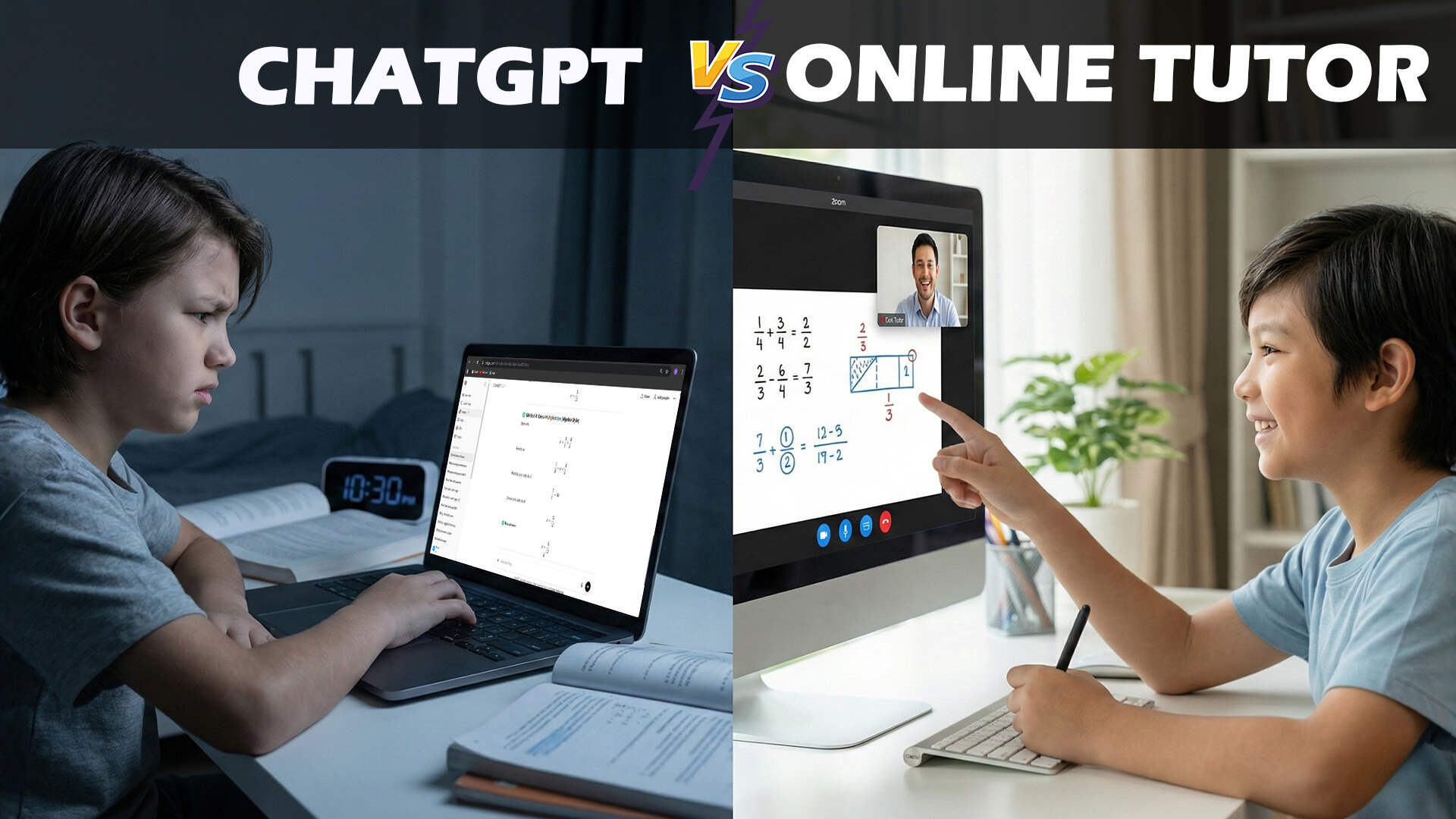
However, there's a deeper question parents need to consider: Can artificial intelligence truly replace the human element in math learning? Does a child who types questions into ChatGPT develop the same mathematical understanding as one who works with a live online tutor?
This article explores both sides of this important question. We'll look at what AI tools do well, where they fall short, and most importantly, why human connection remains essential for helping children build genuine math confidence and skills.
The goal isn't to dismiss AI technology. These tools have legitimate uses in education. Instead, we want to help you understand when AI assistance is helpful and when your child needs something more: the guidance, encouragement, and real-time feedback that only a human tutor can provide.
Why Parents Are Using ChatGPT for Math Help
Parents discover ChatGPT and similar AI tools through various channels. A friend might mention it at school pickup. Your teenager might tell you their classmates are using it. Or you might stumble upon it while searching for homework help online.
The appeal is immediate and obvious. Your child has a math problem they're stuck on. You type it into ChatGPT, and within seconds, you have a detailed explanation with step-by-step solutions. No appointment needed. No waiting. No cost.
Many parents turn to AI for homework assistance because traditional options aren't always practical. Hiring a private math tutor can cost between $30 to $80 per hour or more. Group tutoring centers require driving across town. You might not feel confident enough in your own math skills to help with middle school algebra or high school geometry.
ChatGPT fills this gap instantly. Your 7th grader comes home confused about solving multi-step equations. Instead of struggling through it together or waiting until the weekend for a tutoring session, you can get help right now.
Parents appreciate the step-by-step problem-solving aspect. Unlike a simple calculator that just gives an answer, ChatGPT shows the work. It breaks down problems into smaller steps. For a parent trying to help their child, this feels educational rather than just getting the answer.
The tool also generates practice questions. If your child needs to work on fractions, you can ask ChatGPT to create ten practice problems at varying difficulty levels. This seems like a productive way to help your child study.
Convenience drives much of the adoption. Your child might be working on homework at 9 PM when you're too tired to think through complicated word problems. ChatGPT doesn't get tired. It doesn't need to be scheduled. It's simply there whenever your child opens their laptop.
Some parents use AI tools as a backup resource. Maybe your child has an online tutor they meet with twice a week, but they need help on the other days. ChatGPT becomes the in-between solution for quick questions.
The instant feedback appeals to children too. Kids today are used to immediate responses from technology. Waiting 24 hours for a teacher to respond to an email feels unbearably slow compared to the instant answer ChatGPT provides.
For older students who are somewhat independent learners, AI tools offer a way to get unstuck without admitting to parents that they're struggling. A 10th grader might prefer typing a question into ChatGPT over asking mom or dad for help with math.
What ChatGPT Does Well for Math Learning
To understand the full picture, we need to acknowledge what AI tools genuinely do well. ChatGPT has legitimate strengths that make it useful in certain educational contexts.
The most obvious advantage is speed and availability. ChatGPT works 24 hours a day, seven days a week. If your child is studying for a test at 6 AM or working on homework at midnight, the tool is ready to help. This availability removes the scheduling constraints that come with human tutors.
The AI excels at explaining formulas and mathematical procedures. If your child forgets how to use the quadratic formula or can't remember the steps for long division, ChatGPT can provide clear, formatted explanations. The step-by-step breakdowns are often well-organized and easy to follow.
For straightforward computational problems, ChatGPT shows its work clearly. It can demonstrate how to simplify fractions, solve basic equations, or work through percentage calculations with each step labeled and explained.
Repetition is another area where AI shines. A human tutor might get tired of explaining the same concept for the fifth time, but ChatGPT will patiently re-explain the distributive property as many times as needed without any frustration or judgment.
The tool can generate unlimited practice problems. Need 20 two-digit multiplication problems for your 4th grader? ChatGPT can create them instantly. Want 15 linear equation practice questions for your middle schooler? Done in seconds.
For older students who are relatively strong in math and just need occasional clarification, ChatGPT can be quite helpful. A high school junior working through calculus homework might use it to verify their approach to a problem or get a hint when they're stuck.
The AI adapts its explanation style when asked. If the first explanation was too complex, you can request a simpler version. If your child learns better with visual descriptions, you can ask ChatGPT to explain concepts using analogies or real-world examples.
There's no social pressure or embarrassment. Some children feel anxious about asking questions in front of others or admitting they don't understand something. With ChatGPT, there's no judgment. Your child can ask the same question multiple ways without feeling self-conscious.
ChatGPT can also help with homework checking. If your child has worked through a problem set, they can use AI to verify their answers and identify mistakes before submitting the assignment.
For parents who are themselves uncomfortable with math, ChatGPT provides a resource they can use to help their children. Instead of saying "I don't know," parents can work alongside their child to use the AI tool to find explanations.
Where ChatGPT Falls Short for Children
Despite its impressive capabilities, ChatGPT has significant limitations when it comes to actually teaching children mathematics. These aren't minor technical issues—they're fundamental gaps that affect real learning.
The most critical limitation is the complete absence of emotional intelligence. ChatGPT cannot see your child's face. It doesn't notice when your 8-year-old's eyes glaze over because they stopped understanding three steps ago. It can't detect the subtle shift in body language that signals confusion or frustration.
A human tutor watches these cues constantly. They notice when a child starts to disengage and immediately adjusts their approach. If the child looks overwhelmed, the tutor simplifies. If they look bored because the material is too easy, the tutor increases the challenge.
ChatGPT just keeps going, completely unaware that it's lost the student somewhere along the way.
The AI cannot see hesitation or uncertainty. When your child pauses before answering a question, a good tutor recognizes this as an important teaching moment. They might probe: "What are you thinking? What step feels tricky?" ChatGPT has no awareness of these pauses. It waits for typed input and nothing more.
This creates a serious problem: ChatGPT makes answer-copying incredibly easy. Your child can type in their entire homework problem and get a complete solution. There's no verification that they're actually learning the process rather than just copying down the answer.
A live tutor asks follow-up questions. They make the student explain their thinking. They intentionally withhold the final answer until the child works through the problem themselves. ChatGPT has no way to enforce this kind of productive struggle.
Motivation and accountability are entirely absent. ChatGPT doesn't care if your child gives up after two minutes. It doesn't follow up the next day to check if they remembered yesterday's lesson. It can't create the sense of responsibility that comes from knowing someone is tracking your progress.
Children often need external motivation to persist through difficult material. A tutor provides this through encouragement, goal-setting, and genuine interest in the child's progress. ChatGPT provides information but no motivational support whatsoever.
The tool is not designed with child learning psychology in mind. It processes text input and generates text output. It doesn't understand that an 11-year-old's brain works differently than a 16-year-old's brain. It doesn't adjust for developmental stages or recognize age-appropriate explanations.
ChatGPT often gives explanations that are technically correct but developmentally inappropriate. It might explain fractions using concepts that a 3rd grader hasn't learned yet. A human tutor naturally calibrates their language and examples to match the child's age and experience.
The AI cannot build on previous sessions in a meaningful way. While ChatGPT can reference earlier parts of a conversation, it has no genuine understanding of your child's learning journey. It doesn't remember that last week your child finally grasped negative numbers but still struggles with word problems.
There's no relationship building. Children learn better when they feel connected to their teacher or tutor. Trust, rapport, and personal connection create a foundation for effective learning. ChatGPT is a tool, not a person. There's no relationship to build.
ChatGPT cannot identify underlying learning gaps. When a child struggles with algebra, the problem might actually be weak fraction skills from elementary school. A skilled tutor recognizes these foundational gaps and addresses them. ChatGPT just answers the question asked without diagnosing deeper issues.
The tool reinforces passive learning. Your child types a question and receives information. This is fundamentally different from active learning where a student grapples with concepts, makes attempts, receives feedback, and tries again. ChatGPT enables passive consumption of information.
How Children Actually Learn Math (Educational Psychology)
Understanding how children genuinely learn mathematics is essential for evaluating any learning tool or method. Math learning isn't just about memorizing formulas or following steps—it's a complex cognitive process.
True math learning requires conceptual understanding, not just procedural memorization. A child might memorize that you "flip and multiply" when dividing fractions, but do they understand why this works? Can they explain the concept behind the procedure?
Conceptual understanding means grasping the "why" behind mathematical operations. When children understand concepts, they can apply their knowledge to new situations. When they only memorize procedures, they're lost the moment a problem looks unfamiliar.
Research in mathematics education consistently shows that confidence is crucial for math learning. Math anxiety is real and can significantly impair a child's ability to learn. Children who feel anxious about math perform worse, even when they have the underlying ability.
Building confidence requires success experiences, but not just any success. Children need to feel they earned their success through effort and understanding, not through shortcuts or copying answers. Genuine confidence comes from solving problems independently with appropriate support.
Encouragement and positive interaction matter enormously in mathematics learning. When a child attempts a difficult problem and a caring adult says, "I can see you're really thinking about this. You're on the right track," this encouragement helps the child persist through difficulty.
The social aspect of learning is powerful for children. Young learners especially benefit from verbalizing their mathematical thinking. When a child explains their reasoning out loud to someone who's listening and responding, they often clarify their own understanding in the process.
This is why talking through math problems with a tutor is fundamentally different from typing questions into AI. The act of verbal explanation—with someone listening, asking questions, and engaging with their ideas—deepens learning in ways that written interaction with AI cannot replicate.
Children need to ask questions out loud for several reasons. First, forming a question requires organizing their confusion into words, which is itself a learning process. Second, hearing themselves speak sometimes helps children recognize their own misunderstandings.
Third, the immediate back-and-forth of live conversation allows for clarification and adjustment. A child starts to ask one question, realizes mid-sentence that's not quite their confusion, and adjusts the question. A tutor follows this thinking process. ChatGPT only responds to what's typed.
Math learning for children involves multiple attempts and productive struggle. Educational research emphasizes that struggling with problems—when properly supported—leads to deeper learning than being given answers quickly. Children need space to try, fail, try again, and eventually succeed.
This productive struggle happens in a supportive environment where mistakes are learning opportunities. A child attempts a problem, gets it wrong, and a tutor helps them understand why without making them feel bad. This cycle of attempt, error, feedback, and revision is how deep learning occurs.
Children also learn through observation and modeling. They watch how an adult approaches problems, how they think through steps, how they check their work. This modeling happens naturally in live tutoring sessions but is absent when a child works alone with AI.
The emotional state of the learner matters tremendously. A child who feels safe, supported, and believed in learns better than one who feels anxious or judged. Creating this emotional safety is something human tutors do naturally but AI cannot provide.
Different children learn at different paces and need different amounts of practice. Some children grasp multiplication quickly while others need weeks of practice. A human tutor adjusts the pace and amount of practice to each child's needs. ChatGPT delivers information at whatever pace the user requests, without any sense of what's appropriate.
Why Human Connection Is Critical in Math Learning
The human element in math tutoring provides something AI fundamentally cannot: genuine connection and responsive interaction. This isn't a minor extra feature—it's central to effective teaching.
Human tutors read facial expressions and body language constantly. A furrowed brow, a hesitant pause, a sudden smile of understanding—these nonverbal cues guide how a tutor proceeds. When a child's face shows confusion, a good tutor stops and reapproaches the concept differently.
These visual cues happen in real-time during online tutoring sessions through video chat. The tutor sees the child's reactions as they work through problems together. If the child looks overwhelmed, the tutor simplifies. If they look bored because the material is too easy, the tutor increases the challenge.
This real-time adjustment is impossible with AI. A child might be completely confused after ChatGPT's first explanation, but if they don't know how to articulate their confusion, they're stuck. They might just copy the answer and move on, learning nothing.
Human tutors adjust their explanations moment by moment based on student response. They might start explaining fractions one way, notice the child isn't connecting, and immediately switch to a different approach. This flexibility happens dozens of times in a single tutoring session.
The ability to read confusion is especially important with younger children who may not have the vocabulary or self-awareness to say "I don't understand this specific part." A tutor sees the confusion and addresses it. ChatGPT remains oblivious unless the child can precisely articulate their confusion.
Human connection encourages curiosity in powerful ways. When a child asks "Why does this work?" and sees a tutor's face light up with enthusiasm for the question, it validates curiosity. The emotional response communicates that questions are valuable and thinking deeply is important.
A tutor might say, "That's a great question! Let me show you something cool about why this works." The tone of voice, the excitement, the personal engagement—all of this encourages the child to keep asking questions and thinking deeply about mathematics.
Creating a safe space to make mistakes is perhaps the most important aspect of human connection in learning. Children need to feel that making errors is okay—in fact, necessary for learning. A skilled tutor creates this environment through their responses to mistakes.
When a child makes an error, a good tutor might say, "Interesting approach! Let's look at what happens when we follow your thinking." This response shows the child that their effort is valued even when the answer is wrong. The tutor uses the mistake as a teaching opportunity without any judgment.
This emotional safety is critical for math learning because fear of being wrong causes many children to shut down. They stop trying, stop participating, and develop math anxiety. A human tutor can prevent this through their emotional responsiveness.
The relationship between tutor and student creates accountability in a positive way. The child knows their tutor cares about their progress. They don't want to disappoint someone who believes in them. This healthy accountability motivates effort in ways that using a tool never can.
Human tutors provide encouragement that feels genuine because it is genuine. When a child solves a difficult problem and hears "I'm so proud of how you worked through that! You didn't give up even when it was tough," they internalize this praise in meaningful ways. ChatGPT can generate encouraging text, but it lacks the authenticity of human praise.
The emotional connection also helps during frustrating moments. Math can be frustrating, and children sometimes want to give up. A human tutor provides emotional support: "I know this feels hard right now. Let's take a breath and break it down into smaller pieces." This kind of empathetic support helps children build resilience.
Live interaction allows for the natural give-and-take of conversation. A child might say something that reveals a misconception, and the tutor immediately addresses it. The child asks a question that leads to a productive tangent. These organic learning moments can't happen with AI's rigid input-output structure.
Human tutors adapt to the child's personality and learning style. An energetic tutor might use humor and excitement with one child while taking a calmer, more patient approach with another child who's anxious. This personality matching is crucial for effective learning but impossible for AI.
What an Online Math Tutor Provides That AI Cannot
Online tutoring combines the convenience of digital access with the essential human elements of teaching. Understanding what live tutors uniquely provide helps clarify why AI alone isn't sufficient for children's math learning.
Personalized learning plans are foundational to effective tutoring. After assessing a child's current knowledge, strengths, and gaps, a tutor creates a structured plan for progress. This plan evolves week by week based on the child's development.
For example, a tutor might discover that your 5th grader struggles with multi-digit multiplication because they never fully mastered their basic multiplication facts. The tutor then creates a plan that strengthens those foundations while gradually building toward multi-digit problems.
ChatGPT has no such planning ability. It responds to isolated questions without any larger educational strategy. There's no curriculum, no scaffolded progression, no intentional skill-building sequence.
Live feedback and instant correction happen during problem-solving, not after. As your child works through a problem during an online tutoring session, the tutor watches their work. When they make an error, the tutor intervenes immediately: "Let's pause here. Look at this step again."
This instant correction prevents children from practicing mistakes. If your child does ten practice problems using the wrong method, they're reinforcing incorrect learning. A tutor catches the error on problem one and guides them to the correct approach.
With ChatGPT, children typically work independently and might practice problems incorrectly multiple times before seeking help. By then, the incorrect method has been reinforced, making it harder to unlearn.
Motivation and accountability in online tutoring come from the relationship. Your child knows they'll meet with their tutor next week. The tutor will ask about practice problems. This expectation motivates children to engage with the material between sessions.
The tutor also sets specific goals: "By our next session, I want you to be confident solving these types of problems." Children work toward these goals because someone they respect has expectations for them.
Progress tracking happens over weeks and months. The tutor maintains notes about what they've covered, what the child has mastered, and what needs more work. They see patterns: this child always struggles with word problems but excels at computation.
This longitudinal view allows tutors to identify trends that wouldn't be visible in isolated problem-solving sessions. They might notice that the child's confidence is growing, or that certain types of problems consistently cause difficulty.
Tutors also communicate with parents about progress. After sessions, a tutor might send updates: "We worked on fractions today. She's getting more confident with adding unlike denominators but still needs practice with word problems involving fractions."
This communication keeps parents informed and allows them to support learning at home. ChatGPT provides no such feedback loop.
Online tutors teach study skills and problem-solving strategies that go beyond specific math content. They show children how to approach difficult problems systematically, how to check their work, and how to learn from mistakes.
These metacognitive skills—thinking about their own thinking—are crucial for long-term academic success. Children who learn effective problem-solving strategies carry these skills across all subjects and throughout their education.
Tutors also identify when a child needs to slow down or when they're ready to move faster. Pacing is critical in mathematics because rushing through foundational concepts creates problems later, while moving too slowly can bore capable students.
The social accountability of scheduled sessions also establishes routine and structure. Your child has tutoring every Tuesday and Thursday at 4 PM. This regular structure creates consistency in learning that random AI interactions cannot provide.
Online tutors can coordinate with classroom teachers and curriculum. If your child's school is covering specific topics, the tutor can provide additional support on those exact concepts. This alignment reinforces classroom learning in ways that standalone AI problem-solving cannot.
Real-Life Parent Scenarios
Understanding these concepts becomes clearer when we look at real situations parents face. These scenarios illustrate how children interact with AI versus human tutors.
Scenario 1: The Child Using ChatGPT But Still Confused
Maria's 7th grade daughter Emma has been using ChatGPT for her pre-algebra homework for about a month. Emma seems to be getting her homework done more independently, which Maria initially thought was progress.
However, when Emma's math test came back, Maria was shocked. Emma scored poorly despite having complete homework assignments all month. When Maria asked what happened, Emma said, "I don't know. The test was really different from the homework."
What actually happened? Emma had been typing her homework problems into ChatGPT and copying down the solutions. She understood the answers while copying them, but she never truly learned the underlying concepts.
When the test presented problems in slightly different formats, Emma couldn't apply what she thought she knew. ChatGPT had given her answers, but she hadn't developed actual mathematical understanding.
Maria realized that Emma needed more than answer access. She needed someone to work with her, ensure she understood concepts, and verify her independent work.
Scenario 2: An Online Tutor Identifying Learning Gaps
David noticed his 5th grade son Marcus was struggling with division. Marcus seemed to get the concept during homework time but made frequent errors.
David hired an online math tutor to work with Marcus twice a week. During the first session, the tutor had Marcus solve several division problems while explaining his thinking process.
The tutor quickly identified the real issue: Marcus had gaps in his multiplication facts. He was trying to do division problems without quick recall of multiplication, which slowed him down and led to errors.
The tutor then created a plan that included strengthening multiplication fluency while simultaneously building division skills. Within a few weeks, Marcus's speed and accuracy improved dramatically.
ChatGPT would have answered Marcus's division questions without ever identifying that the underlying problem was multiplication fluency. The AI responds to surface-level questions without diagnosing root causes.
Scenario 3: Confidence Building Through One-on-One Tutoring
Aisha's 9-year-old daughter Sophie had developed significant math anxiety. Sophie would get visibly stressed during homework time and often said things like "I'm bad at math" or "I'll never understand this."
Aisha tried using ChatGPT to help make homework easier, thinking that quick answers might reduce Sophie's stress. Instead, Sophie became even more anxious because she felt she was cheating but still didn't understand the material.
Aisha then found an online tutor who specialized in working with anxious students. The tutor spent the first few sessions just building rapport with Sophie, working on easy problems to build confidence, and celebrating small successes.
The tutor never made Sophie feel bad about not knowing something. Instead, she constantly reinforced the idea that confusion is normal and mistakes are how we learn. Over several months, Sophie's anxiety decreased noticeably.
Sophie began saying things like "This is hard, but I think I can figure it out" instead of "I can't do this." Her math grades improved, but more importantly, her relationship with math transformed.
This confidence building required human emotional intelligence, patience, and relationship building—elements completely absent from AI interactions.
Scenario 4: The Middle School Student Finding Shortcuts
Jennifer's 8th grade son Kyle discovered he could use ChatGPT to complete his math homework in minutes instead of the hour it usually took. Kyle thought he was being efficient.
For several weeks, Kyle's homework grades remained strong. Jennifer had no idea anything was wrong. Then came the chapter test—and Kyle failed it.
When Jennifer asked Kyle what happened, he initially couldn't explain it. Eventually, he admitted he'd been using ChatGPT for all his homework. He genuinely thought understanding the answers when he copied them meant he was learning.
Jennifer realized that while ChatGPT provided answers, it didn't create the productive struggle that actual learning requires. Kyle needed to work through problems independently, make mistakes, and develop his own problem-solving processes.
Jennifer found a tutor who worked with Kyle on learning strategies, not just math content. The tutor would present a problem and then wait, letting Kyle struggle productively before providing hints. This approach helped Kyle develop genuine problem-solving skills.
Best Learning Approach: AI + Online Tutor Together
The most effective approach isn't choosing between AI and human tutors—it's understanding how to use both strategically for your child's benefit.
AI tools like ChatGPT work best as supplementary resources, not primary teaching tools. They're excellent for specific, limited purposes when used appropriately within a larger learning framework.
Use AI for practice and revision after your child has already learned a concept with their tutor. If your child's online tutor taught solving two-step equations this week, ChatGPT can generate additional practice problems for homework.
This approach keeps AI in its proper role: providing extra practice opportunities without replacing the teaching and guidance that must come from humans.
AI can help with quick factual recall. If your child forgets the formula for the area of a triangle while working on homework, ChatGPT can provide this information quickly. This is similar to looking up information in a textbook—useful but limited.
Online tutors should lead all new concept learning. When your child encounters material they've never seen before, the tutor introduces it, explains it, checks for understanding, and ensures the foundation is solid.
The tutor creates the conceptual understanding. They answer why questions. They connect new concepts to what the child already knows. They build the mental framework that allows the child to apply knowledge independently.
After the tutor has established this foundation, AI tools can support practice. Your child can use ChatGPT to check their work on practice problems, generate additional similar problems, or review procedures they've already learned.
This hybrid approach works because each tool does what it does best. Tutors provide teaching, connection, feedback, and guidance. AI provides convenience, unlimited practice, and instant information access.
Parents play an important monitoring role in this hybrid approach. You need to ensure your child isn't using AI to bypass learning. Set clear guidelines: "You can use ChatGPT to check your work after you've completed the problems, but not to get the answers initially."
Many families establish a rule that homework must be attempted independently first. After your child has worked through problems on their own, they can verify answers using AI. This ensures the primary learning work happens without shortcuts.
The tutor should know your child is using AI tools and can incorporate this into their approach. They might ask, "Did you use ChatGPT this week? Show me how you used it." This transparency helps the tutor understand what support your child is receiving outside of tutoring sessions.
Regular tutoring sessions create accountability that prevents AI use from becoming answer-copying. When your child knows the tutor will ask them to solve problems independently in the next session, they're motivated to actually learn rather than just copying AI-generated answers.
For test preparation, this hybrid approach is particularly effective. The tutor identifies what concepts need strengthening, teaches or reviews them, and then the child uses AI-generated practice problems to build fluency.
The key is maintaining proper balance. Tutoring remains the primary learning method—typically two to three sessions per week for children who need significant support. AI serves as a study tool between sessions.
Parents should watch for warning signs that AI use is becoming problematic. If your child's homework is always perfect but their test grades are poor, they're likely copying answers rather than learning. If they panic when they can't access AI during tests, they've become dependent on it.
Communication between parents, tutors, and children is essential. Everyone should understand the role of AI in the learning process and ensure it's being used appropriately.
When ChatGPT Is Enough (And When It's Not)
Understanding when AI tools suffice versus when human tutoring is necessary helps parents make informed decisions about their child's math support.
For older high school students who have strong math foundations and self-directed learning skills, ChatGPT can be adequate for certain purposes. A capable 11th grader working through calculus homework might use AI to check their work or get hints when stuck.
These students already have the conceptual understanding and study skills to use AI effectively. They can recognize when an AI explanation doesn't make sense. They know how to verify answers and cross-check information.
However, even strong students benefit from human tutoring when learning new complex concepts or preparing for important exams. The AP Calculus exam, for example, tests deep understanding that requires more than memorized procedures.
For younger children (ages 5-12), ChatGPT should almost never be the primary learning tool. Elementary and middle school students are building foundational skills and haven't yet developed the metacognitive abilities to use AI effectively.
These younger learners need human guidance to develop number sense, conceptual understanding, and problem-solving strategies. They cannot effectively self-regulate their learning with AI alone.
The distinction between homework help and foundational learning matters significantly. Using AI to check a few homework answers is different from relying on it to teach new concepts.
If your child learned fractions from their teacher or tutor and just needs to practice a few problems at home, ChatGPT can verify their answers. But if your child didn't understand fractions in class and tries to learn them from AI, they're unlikely to develop real understanding.
For homework support, AI might be acceptable when your child needs to verify their work on material they've already learned. For foundational learning of new concepts, human instruction is essential.
Warning signs that your child needs a tutor instead of relying on AI:
Homework is complete, but test scores are poor. This indicates your child is getting answers without understanding concepts.
Your child becomes anxious or helpless when technology isn't available. If they panic during tests because they can't use ChatGPT, they've become dependent rather than developing actual skills.
Your child can't explain their math work. Ask them to show you how they solved a problem. If they can only read back what ChatGPT wrote but can't explain it in their own words, they haven't learned.
Grades are declining despite completing homework. This suggests the homework isn't leading to actual learning.
Your child rushes through homework using AI, then spends no time reviewing or practicing. Real learning requires engagement, not just answer-getting.
Math confidence is decreasing rather than increasing. If your child seems less confident over time despite using AI help, something isn't working.
Your child avoids word problems or application questions. These require deeper understanding that AI shortcuts can't provide.
Age-appropriate guidelines for AI use in math:
Elementary school (ages 5-10): Minimal to no AI use for math learning. These children need human instruction to build foundations. AI tools aren't designed for early learners.
Middle school (ages 11-13): Limited, supervised AI use only after concepts are taught by a teacher or tutor. Parents should monitor all AI interactions and ensure the child can explain their work independently.
High school (ages 14-18): Moderate AI use acceptable for homework checking and practice problem generation, but new concept learning should still involve human instruction. Students preparing for standardized tests (SAT, ACT) benefit from tutors who understand test strategies.
For children with learning differences or math anxiety, human tutoring is almost always necessary regardless of age. These students need the emotional support, pacing adjustments, and individualized strategies that only human tutors provide.
Online Private Tutoring vs Self-Learning with AI
A direct comparison helps parents understand the fundamental differences between these two approaches.
When it comes to personalization, online private tutoring provides individualized learning plans tailored to each child's needs, while self-learning with AI offers only generic responses to whatever questions are asked. A tutor assesses your child's strengths and weaknesses, then builds a strategic curriculum. ChatGPT simply answers isolated questions without any cohesive educational plan.
The quality of feedback differs dramatically. With online tutoring, children receive real-time, context-aware feedback as they work through problems. The tutor watches, guides, and corrects immediately. With AI, feedback comes only after completion, and there's no verification that the child is actually learning versus just copying answers.
Emotional support is perhaps the starkest difference. Human tutors provide encouragement, motivation, and relationship building that creates a foundation for learning. AI offers no emotional connection whatsoever—it's simply a tool that processes inputs and generates outputs.
For teaching new concepts, online tutors use multi-sensory explanations with examples, analogies, discussion, and back-and-forth interaction. They adjust their teaching based on the child's responses. AI provides text-based explanations only, with no ability to read comprehension or adjust in real-time.
Error correction works differently in each approach. With a tutor, mistakes are caught immediately during the learning process. The tutor intervenes the moment a child goes down the wrong path. With AI, children often practice problems incorrectly multiple times before seeking help, by which point the incorrect method has been reinforced.
Accountability comes from the tutoring relationship. Regular sessions create structure and responsibility. Your child knows they'll meet with their tutor, who will check their progress. AI provides no external accountability—children can disengage at any moment with no consequences.
Learning assessment happens continuously with a tutor who evaluates understanding and adjusts instruction. AI has no assessment capability. It answers questions without any sense of whether the child truly comprehends the material.
Problem-solving skills develop when tutors teach children how to approach difficult problems independently, think strategically, and persist through challenges. AI typically provides complete solutions, which doesn't build problem-solving capacity.
Long-term planning is foundational to tutoring. The tutor creates a strategic curriculum with intentional skill progression over weeks and months. AI has no planning ability—each interaction is isolated from the next.
Parent communication keeps families informed. Tutors provide regular updates about progress, challenges, and areas needing support. AI offers no feedback mechanism for parents.
Cost considerations are real. Online tutoring typically costs between $30-80 per hour, which represents a significant investment for families. AI tools are free or low-cost, making them financially accessible.
However, availability favors AI. ChatGPT works 24/7, while tutors require scheduled sessions. This convenience makes AI appealing for off-hours homework help.
The most important difference is in building genuine mathematical confidence. Children who work with tutors typically become more confident over time because they're developing real skills with human support. Students relying primarily on AI often become less confident because they know they haven't truly learned independently and feel helpless without the tool.
The learning outcomes show clear patterns. Students with regular tutoring support tend to demonstrate steady improvement in both grades and actual mathematical ability. Their foundation strengthens over time. Students relying mainly on AI often show flat or declining trajectories. Homework grades might stay stable while test scores and true understanding stagnate or decrease.
The level of parent involvement required also differs significantly. With online tutoring, parents coordinate sessions and monitor general progress, but the tutor handles the teaching. This reduces parent stress. With AI-only approaches, parents must heavily monitor usage, verify learning is occurring, check understanding, and essentially supervise the entire educational process. Many parents find this exhausting and ineffective.
Frequently Asked Parent Questions
Parents have legitimate questions about AI tools and tutoring. Here are clear, honest answers to the most common concerns.
Is ChatGPT Safe for Kids?
ChatGPT itself is generally safe from a content perspective, though it's designed for users 18 and older. Younger users technically need parental supervision. The safety concerns aren't primarily about inappropriate content but about educational effectiveness.
The real question isn't whether ChatGPT is dangerous but whether it's appropriate for children's learning. The answer is: only with significant supervision and limitations.
For educational use, parents should supervise all AI interactions with younger children. Sit with your child when they use these tools. Make sure they're using AI appropriately and actually learning.
Set clear boundaries about when and how your child can use AI for homework. Establish rules that prevent answer-copying and ensure genuine learning.
From a data privacy perspective, be aware that information entered into AI tools may be used to train future models. Don't have your child input personal information beyond necessary academic content.
Can AI Replace Teachers or Tutors?
No, AI cannot replace human teachers or tutors for children's education. This isn't about future AI capabilities—it's about the fundamental nature of how children learn.
Teaching involves relationship building, emotional connection, real-time responsiveness, and understanding developmental stages. These are inherently human qualities that current AI doesn't possess.
Even as AI technology advances, the human elements of teaching remain crucial. Children need role models, mentors, and caring adults who believe in them. They need someone who sees them as a whole person, not just a question-answering service.
Good teaching requires reading subtle cues, adapting moment-by-moment, providing emotional support, and building relationships. These capabilities define human teaching and are far beyond what AI tools currently offer.
AI can be a useful tool that teachers and tutors incorporate into their teaching, but it cannot provide the core human functions of education.
Is Online Math Tutoring Effective for Children?
Yes, online math tutoring is highly effective when done well. Research and countless parent experiences confirm that live, one-on-one online tutoring produces strong learning outcomes.
The key is finding qualified tutors who understand how to teach online effectively. Good online tutors use virtual whiteboards, screen sharing, and video interaction to create engaging learning experiences.
Online tutoring offers advantages even over in-person tutoring in some ways. Sessions can be recorded for review. Digital tools allow for interactive problem-solving. Scheduling is often more flexible without commute time.
Children often feel more comfortable at home in their own space, which can reduce anxiety and improve focus. The familiar environment helps some children engage more openly.
The effectiveness depends on several factors: tutor quality, session frequency, child's learning style, and parent support. When these elements align, online tutoring is as effective as in-person tutoring and often more convenient.
How Often Should My Child Meet with a Tutor?
Frequency depends on your child's needs and goals. For children struggling significantly with math, two to three sessions per week typically produces the best results. This frequency provides regular support while allowing time for practice between sessions.
For maintenance or modest enrichment, one session per week might suffice. This keeps skills sharp and provides help with homework questions.
Before major tests or during particularly challenging units, temporarily increasing session frequency can help. Some families do intensive tutoring (daily sessions) for a week or two before important exams.
Consistency matters more than frequency. Regular weekly sessions typically produce better outcomes than sporadic, irregular tutoring.
Should My Child Use AI at All for Math?
AI tools aren't inherently bad—they're powerful tools that need appropriate boundaries. Think of AI like a calculator: useful for certain purposes but not a replacement for learning math.
Used properly as a supplementary resource, AI can be helpful. The key is ensuring it supports learning rather than replacing it.
Set clear guidelines with your child about appropriate AI use. Make sure they understand that using AI to bypass learning will hurt them on tests and damage their long-term education.
For younger children (elementary school), minimal AI use is best. These students need foundational learning that AI cannot provide.
For older students with strong foundations, AI can be a helpful study tool when used appropriately alongside human instruction.
Expert Insights: A Tutor's Perspective
Understanding what experienced math tutors observe provides valuable perspective for parents. Here's what tutors consistently see in their work with children.
One common mistake children make is thinking they understand material when they've only seen someone else solve it. A child watches a ChatGPT explanation and thinks, "That makes sense." But understanding someone else's work is different from being able to do it yourself.
Tutors call this "illusion of understanding." When tutors ask students to solve a similar problem independently, they often discover the child cannot apply what they thought they understood.
Another frequent mistake is skipping foundational concepts. Children want to jump to the current homework topic without ensuring earlier concepts are solid. AI enables this by answering any question without checking whether the student has necessary prerequisite knowledge.
Good tutors identify these gaps and fill them, even when it means going back to review material from previous grades. A child cannot succeed with fractions if they don't understand factors and multiples, regardless of what grade they're in now.
Tutors observe that children who use AI for homework often develop helpless behaviors. They immediately turn to external resources when facing any difficulty, rather than developing internal problem-solving strategies.
These students lack persistence. When a problem seems hard, their first instinct is to seek the answer rather than work through the challenge. This pattern damages long-term learning and academic development.
From a tutor's perspective, guidance and feedback during the learning process matter more than any other factor. The teaching happens in those moments when a child is stuck and the tutor provides just enough help to keep them moving without giving away the answer.
This scaffolding—providing support that gradually decreases as the child develops competence—is the heart of effective teaching. AI cannot provide this because it either gives complete solutions or nothing.
Experienced tutors emphasize that math teaching is relationship work as much as content work. Children learn better when they feel connected to their tutor, when they believe the tutor cares about their progress.
This relationship creates a context where children take appropriate academic risks. They attempt difficult problems because they trust their tutor will support them through mistakes. This risk-taking is essential for learning.
Tutors also stress the importance of teaching students to be comfortable with confusion. Initial confusion when learning something new is normal and healthy. The skill is learning to sit with that confusion and work through it rather than immediately seeking answers.
AI use often short-circuits this process. Children feel confused, immediately turn to ChatGPT, and never develop the tolerance for productive struggle that leads to deep learning.
Finally, tutors consistently observe that mathematical confidence is fragile and must be carefully nurtured. One negative experience can significantly damage a child's math confidence, while patient support over time can rebuild it.
This confidence-building requires human emotional intelligence, encouragement, and genuine caring—elements that AI fundamentally cannot provide.
Final Verdict for Parents
After examining AI tools and online tutoring from multiple angles, what should parents conclude about supporting their child's math learning?
The evidence is clear: human connection through online tutoring remains essential for children's math education. AI tools have specific uses, but they cannot replace the teaching, relationship building, and personalized support that live tutors provide.
ChatGPT and similar AI tools work best as supplementary resources within a learning framework led by human instruction. They're useful for practice problems, homework checking, and quick reference—but not for primary teaching or developing mathematical understanding.
For your child to genuinely learn mathematics, they need more than access to information. They need guided practice, responsive feedback, emotional support, and someone who understands how children learn and develop.
Online tutoring provides all of these elements while also offering convenience and flexibility. Through video-based sessions, children connect with qualified tutors who can teach, guide, encourage, and adjust instruction in real-time.
This human element is not optional or old-fashioned—it's fundamental to how children learn. Mathematical understanding develops through interaction, conversation, feedback, and relationship within a supportive context.
As a parent, you want three things for your child's math learning: confidence, clarity, and consistency.
Confidence comes from authentic success experiences with appropriate support. Your child needs to solve problems themselves with guidance, not copy answers. They need encouragement from someone who believes in their abilities.
Clarity comes from explanations tailored to your child's current understanding, with immediate feedback when confusion arises. This requires a tutor who can read your child's responses and adjust teaching accordingly.
Consistency comes from regular sessions with the same tutor who understands your child's learning journey, tracks their progress, and ensures concepts build appropriately over time.
These three elements—confidence, clarity, and consistency—are what online tutoring uniquely provides and what AI tools cannot replicate.
Your decision about supporting your child's math learning should prioritize long-term outcomes over short-term convenience. Yes, AI provides instant answers. But does it build the deep understanding and problem-solving skills your child needs?
The goal isn't just getting through tonight's homework. It's developing mathematical competence and confidence that will serve your child throughout their education and life.
Investing in quality online tutoring is investing in your child's educational foundation. The benefits extend far beyond math grades to include study skills, persistence, confidence, and a growth mindset.
For children struggling with math, tutoring is often the intervention that changes their entire academic trajectory. For children doing well, tutoring can provide enrichment and challenge that deepens their love of learning.
The question isn't whether your child needs support—most students benefit from it. The question is what kind of support will actually help them learn.
Next Steps: Finding the Right Support for Your Child
You now understand why human-led online tutoring remains essential for your child's math learning. Here's how to move forward with this knowledge.
Start by honestly assessing your child's current situation. How are they really doing in math? Look beyond homework completion to actual understanding. Can they explain their math work? Are test scores matching homework grades?
If your child is struggling, showing signs of math anxiety, or experiencing declining confidence, prioritizing tutoring support is wise. Don't wait until problems become severe—early intervention produces better outcomes.
For finding online tutors, look for qualified individuals with teaching experience and genuine understanding of child development. The best tutors have both mathematical knowledge and the ability to connect with children.
Ask potential tutors about their approach to building confidence and handling mistakes. Their answers will reveal whether they understand the emotional aspects of math learning.
Consider starting with two sessions per week for the first month to establish momentum and assess progress. Many students need this frequency initially to overcome challenges and build new habits.
Communicate with your child about the role of AI tools. Explain that these tools have a place but cannot replace genuine learning. Set clear boundaries about appropriate use.
Monitor your child's progress through both grades and observed confidence. True progress shows in both metrics. If grades improve but your child still seems anxious about math, something isn't working.
Stay involved by asking your child to explain their math work to you. Even if you're not confident in math yourself, you can tell whether your child genuinely understands or is just repeating memorized steps.
Remember that building strong math skills is a gradual process. Expect steady
Ready to Give Your Child the Support They Deserve?
If you're looking for quality online math tutoring that combines expert instruction with genuine human connection, Tutree offers personalized one-on-one sessions designed specifically for children aged 5-16.
Our experienced tutors understand that every child learns differently. They don't just teach math—they build confidence, address individual learning gaps, and create a supportive environment where mistakes become learning opportunities.
What Makes Tutree Different
Personalized Learning Plans: Each child receives a customized curriculum based on their current skills, learning style, and goals. No generic one-size-fits-all approach.
Live, Interactive Sessions: Real-time video sessions with qualified tutors who can see your child's reactions, answer questions immediately, and adjust explanations on the spot.
Progress Tracking: Regular updates keep you informed about what your child is learning, where they're excelling, and what needs more practice.
Flexible Scheduling: Sessions that fit your family's busy schedule, with the convenience of learning from home.
Patient, Caring Tutors: We match your child with tutors who understand child development and create the emotional safety needed for effective math learning.
Whether your child is struggling with basic concepts, needs help staying on track, or wants to advance beyond grade level, Tutree provides the human guidance that AI tools simply cannot replace.
Take the First Step
Your child doesn't have to struggle with math alone or rely on shortcuts that don't build real understanding. With Tutree's online tutoring, they'll develop both the skills and confidence to succeed.
Visit Tutree today to learn more about our programs and find the right tutor for your child's unique learning needs. Give your child the gift of genuine understanding, lasting confidence, and a stronger foundation in mathematics.
Related Articles
Is your child avoiding math homework, taking too long to finish assignments, or saying they are “bad at math”? Struggling with mathematics does not mean a child is incapable of learning. Weak foundations, math anxiety, classroom pacing, confusing concepts, and low confidence can all make math more difficult. This guide explains 10 common reasons children struggle with math and offers practical strategies parents can use at home. Learn how to identify math learning gaps, support consistent practi

The Digital SAT 2026 is shorter, smarter, and fully adaptive — but that doesn't mean it's easier without the right preparation. This ultimate guide breaks down exactly how the Digital SAT works, shares the top strategies used by high-scoring students, gives you a complete 90-day score improvement plan, and walks you through how to find reliable online SAT tutoring near you. Whether you're aiming for 1200 or 1500, this guide gives you a clear, actionable road map to your target score.

Math anxiety affects millions of children, causing tears, avoidance, and loss of confidence. This comprehensive guide helps parents recognize emotional, behavioral, physical, and academic signs of math anxiety—from homework meltdowns to test-day panic. Learn why math anxiety is increasing, debunk common myths, and discover actionable strategies to support your child at home.
