How Parents' Words Shape a Child's Confidence
- 20 December 2025
- Published by tutree
- STEM.org Accredited™ Partner

Why Words Matter More Than We Think
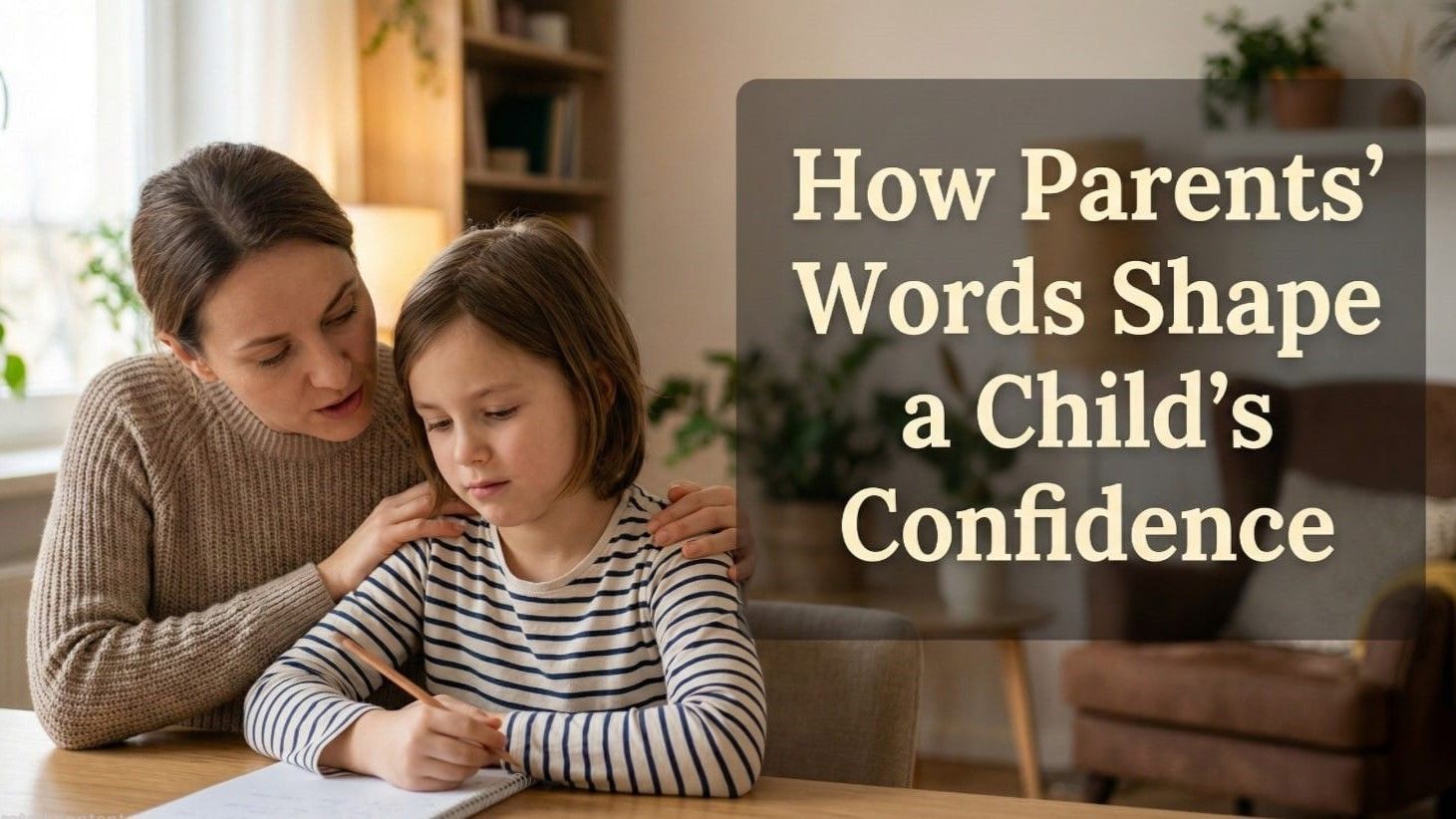
It's 7:30 PM on a Tuesday. Your child is staring at their homework, eraser shavings scattered across the table. You've explained the same math problem three times. Your patience is wearing thin. The words slip out before you can stop them: "Why can't you just focus? This isn't that hard."
Your child's shoulders slump. They look down. You didn't mean to hurt them—you were just tired, frustrated, trying to help. But in that moment, something shifted in how they see themselves.
We've all been there. The exhausted moments when our words come out sharper than we intended. The times we speak without thinking, driven by stress or worry or the simple weight of a long day. And here's the truth that's both difficult and freeing to accept: our children are listening to everything. Not just the big conversations about values and life lessons, but the small, everyday comments we make without thinking twice.
Children don't remember every lesson we teach. They might forget the multiplication tables we drilled, the historical facts we shared, or the step-by-step instructions we carefully laid out. But they remember how our words made them feel. They remember the tone in our voice when they made a mistake. They remember whether we believed in them when things got hard.
Your words become your child's inner voice. When they face a challenge years from now—a difficult test, a friendship conflict, a moment of self-doubt—they'll hear echoes of what you said to them in similar situations. Will they hear "You can figure this out" or "Why can't you get this right?" Will they approach new challenges with curiosity or fear?
This isn't about being a perfect parent. Perfect parents don't exist, and children don't need them. What children need are parents who are aware—aware of the power their words carry, aware of how their tone lands, aware that repair is always possible after a difficult moment.
If you've ever felt guilty after snapping at your child, if you've ever replayed a conversation and wished you'd handled it differently, if you've ever wondered why your capable child seems to doubt themselves—this blog is for you. Not to add more guilt to your plate, but to help you understand what's happening beneath the surface. To give you language that builds up instead of breaking down. To remind you that awareness is the first step toward change, and that your intention to do better already matters.
The relationship between parent and child is one of the most powerful forces in shaping who that child becomes. And while we can't control everything about our children's lives, we can be more intentional about the words we use, the tone we take, and the emotional environment we create at home.
How Children Interpret Parents' Words
Children and adults speak different emotional languages. When you say something as a parent, you're speaking from years of life experience, adult logic, and a brain that can separate intention from delivery. Your child is listening with a completely different processing system.
Kids take words literally, especially younger children. When you say "You're driving me crazy," they might genuinely worry they're hurting you. When you say "You never listen," they believe you mean never—not sometimes, not when they're distracted, but absolutely never. Their brains haven't yet developed the nuance to understand hyperbole or context the way adults do.
More importantly, children interpret words through an emotional filter, not a logical one. You might say "This is the third time I've asked you to clean your room" as a factual observation. Your child hears "I'm disappointed in you" or "You're not good enough." They're not trying to misunderstand you—they're simply reading the emotion behind your words more than the actual content.
Here's something fascinating about children's brains: they remember negative comments far longer and more vividly than positive ones. This isn't because they're pessimistic or ungrateful—it's basic neuroscience. The human brain evolved to prioritize threat detection, and for a child, parental disapproval registers as a social threat. One harsh comment can eclipse ten warm ones in their memory.
Tone matters more than intention. You can say "good job" in a way that feels genuine and encouraging, or in a way that feels dismissive and sarcastic. Your child will respond to how you said it, not what you said. They're incredibly attuned to your facial expressions, body language, and the energy you're carrying into the conversation. When you're stressed about work and trying to help with homework, they feel that stress—and they often internalize it as being about them.
Repetition is where words become beliefs. Say something once in frustration, and your child might shake it off. Say it repeatedly over weeks and months, and it becomes part of how they see themselves. "You're so messy" transforms into "I am a messy person." "You're too sensitive" becomes "My feelings are wrong." "You never think before you act" turns into "I can't be trusted to make good decisions."
This is why casual, repeated phrases can be more impactful than we realize. We might think we're just making an observation or expressing frustration, but our children are building their self-concept from these daily interactions. They're asking themselves: "What do my parents think of me?" And they're finding the answer in our words, our tone, and our reactions.
Children also struggle to separate criticism of behavior from criticism of their identity. When you say "That was a bad choice," they might hear "I am bad." When you say "You didn't try hard enough," they might hear "I am not enough." The distinction between what they do and who they are isn't always clear to them yet.
Common Phrases Parents Say (And How Kids Hear Them)
Let's talk about the phrases we say without thinking—the ones that slip out in moments of frustration or worry. These aren't bad parent moments; they're human parent moments. But understanding how they land can help us make different choices.
"You're not trying hard enough"
What you usually mean: I can see you're capable of more, and I want to motivate you to push yourself because I believe in you.
What your child often hears: Nothing I do is good enough. I'm disappointing my parent. Maybe I'm just not smart enough.
Impact on confidence: This phrase suggests that effort is the only thing standing between them and success, which can be crushing when they genuinely are trying. It teaches them that their best isn't sufficient, leading to either anxiety about never measuring up or giving up entirely because "what's the point?"
"Why can't you be more like [sibling/friend]?"
What you usually mean: I'm trying to help you see what success looks like by pointing to a concrete example.
What your child often hears: You prefer someone else over me. I'm not good enough as I am. My individuality is a problem.
Impact on confidence: Comparison kills confidence faster than almost anything else. It tells children that they should be someone other than themselves. Even well-intentioned comparisons create a sense that love is conditional on matching up to someone else's strengths. This often damages sibling relationships and creates lasting insecurity.
"You always do this" or "You never listen"
What you usually mean: This behavior is happening frequently and it's frustrating me.
What your child often hears: I am permanently this way. I can't change. My parent has given up on me.
Impact on confidence: These absolute statements create a fixed identity in your child's mind. If they "always" mess up or "never" get it right, why try to improve? It removes hope for growth and traps them in a negative narrative about themselves.
"I don't have time right now"
What you usually mean: I'm genuinely busy and need to finish something before I can give you my full attention.
What your child often hears: (Especially when said repeatedly) I'm not important. My needs don't matter. I'm bothering my parent.
Impact on confidence: While it's true that parents can't always be immediately available, this phrase without context can make children feel like a burden. It affects their sense of worth and can make them hesitant to come to you with important things later.
"This is easy, why can't you get it?"
What you usually mean: I'm trying to reassure you that this task isn't as difficult as you think.
What your child often hears: Everyone else finds this simple, so something is wrong with me. I must be stupid if I can't do something "easy."
Impact on confidence: What's easy for one person might be challenging for another, and that's okay. This phrase makes children feel isolated in their struggle and ashamed of needing help. It can create intense pressure to hide when they don't understand something.
"Stop crying" or "You're fine"
What you usually mean: I don't want you to feel bad, and I'm trying to help you move past this upset feeling.
What your child often hears: My feelings are wrong. I shouldn't feel what I'm feeling. I need to hide my emotions.
Impact on confidence: Emotional confidence is just as important as academic or social confidence. When we dismiss feelings, we teach children not to trust their own emotional responses. This can lead to suppressed emotions, difficulty with emotional regulation, and trouble expressing needs in healthy ways.
"I'm disappointed in you"
What you usually mean: Your behavior in this specific situation didn't meet my expectations.
What your child often hears: I have failed as a person. I am a disappointment to the most important people in my life.
Impact on confidence: Disappointment is a heavy emotion for a child to carry. It's not that you should never feel disappointed, but expressing it this way can make children feel like they've fundamentally let you down. It often creates shame rather than motivation to do better.
"You're so [negative trait]" (lazy, difficult, dramatic, etc.)
What you usually mean: This specific behavior is frustrating me right now.
What your child often hears: This is who I am. This is my identity. I am defined by my worst moments.
Impact on confidence: Labels stick. Even labels said in frustration become how children see themselves. When you label a child, they often live up (or down) to that label because it becomes their expected role in the family.
The Role of Tone, Body Language, and Timing
The exact same words can build up or tear down depending on how they're delivered. "We need to talk about your grades" said with concern and warmth feels completely different from the same sentence said with disappointment and impatience.
Your tone carries more weight than you might realize. Children are experts at reading emotional undertones. They can detect frustration, distraction, genuine interest, or dismissiveness within seconds. You might think you're hiding your stress, but your voice gives it away. A tight voice, a sigh before speaking, or a clipped way of talking all signal to your child that something is wrong—and they often assume that "something" is them.
Consider the difference between these deliveries:
Said calmly, looking at your child: "Let's work through this together. Show me where you're getting stuck."
Said while scrolling your phone, voice rushed: "Just think about it harder. You know how to do this."
Same essential message—but entirely different emotional experience for your child.
Body language amplifies or contradicts your words. Telling your child "I'm here for you" while looking at your screen doesn't feel supportive. Saying "good job" without making eye contact feels empty. Crossed arms while discussing a mistake feels threatening, even if you're not trying to intimidate.
The most powerful conversations with children happen when you physically get on their level—kneeling down to meet their eyes, sitting beside them rather than standing over them, turning your body toward them instead of staying positioned toward what you were doing. These small physical adjustments signal: "You matter. You have my attention. I'm not rushing past this moment."
Timing transforms meaning. The same feedback given when everyone is well-rested and calm lands differently than the same feedback given when your child is hungry, tired, or already emotionally fragile. We've all experienced how much harder criticism hits when we're already feeling low—children are no different.
There's also the question of public versus private guidance. Correcting your child in front of siblings, friends, or family members adds a layer of humiliation that makes it nearly impossible for them to absorb what you're actually trying to teach. What might have been a helpful redirection becomes a shameful memory that damages trust.
The best time for important conversations is rarely in the heat of a frustrating moment. When you're angry, your tone will reflect that. When your child is defensive, they can't really listen. Sometimes the most powerful thing you can say is "Let's both take a breath and come back to this in a few minutes." This models emotional regulation and ensures that when you do talk, you're both in a space to actually connect.
How Negative Self-Talk Starts in Children
There's a heartbreaking phenomenon that happens as children grow: they start talking to themselves the way they've heard others talk to them. Your words don't just stay external—they move inside and become your child's inner voice.
When a child faces a challenge—maybe they can't figure out a puzzle, they miss a shot in a game, or they forget their homework—listen to what they say to themselves. You might hear echoes of phrases you've used: "I'm so stupid," "I never get anything right," "Why can't I just do this?"
This internal dialogue doesn't come from nowhere. It's learned from the environment, primarily from parents and other close adults. If a child repeatedly hears "You're not trying hard enough," that becomes what they tell themselves when something is difficult. If they hear "You always mess things up," that becomes their automatic thought when they make a mistake.
Here's what makes this especially challenging: even capable, talented children can develop intense negative self-talk that has nothing to do with their actual abilities. You might have a child who excels in school but is convinced they're "not smart." You might have a creative child who refuses to try new things because they're certain they'll "fail." Their negative self-perception isn't based on reality—it's based on the messages they've internalized.
Fear of mistakes often traces back to how mistakes were handled at home. If mistakes were met with frustration, disappointment, or criticism, children learn that mistakes are catastrophic rather than normal parts of learning. They become perfectionists who would rather not try than risk failing. They hide struggles instead of asking for help. They equate any error with personal inadequacy.
This is how anxiety builds in children. The internal pressure to be perfect, to never disappoint, to always meet expectations becomes exhausting. They start avoiding anything that might reveal imperfection—new challenges, difficult conversations, situations where they might not immediately succeed.
The saddest part is watching children who had natural curiosity and enthusiasm gradually become hesitant and self-doubting. The shift often happens so gradually that parents don't notice until the confidence is already deeply eroded. A child who used to eagerly show you their artwork now hides it. A child who used to ask endless questions now stays quiet. A child who used to try new things now sticks rigidly to what they know they can do well.
This negative self-talk becomes self-reinforcing. Once a child believes "I'm bad at math," they approach math with anxiety, which affects performance, which confirms their belief. The narrative gains power through repetition, becoming harder to challenge over time.
But here's the hopeful truth: just as negative self-talk is learned, positive self-talk can be taught. The voice inside your child's head can change when the voice they hear from you changes. It takes time and consistency, but children's brains are remarkably adaptive. New patterns can replace old ones.
What to Say Instead: Confidence-Building Language
Let's rebuild. For every phrase that diminishes, there's language that builds up. The goal isn't to eliminate all frustration or pretend everything is perfect—it's to communicate in ways that separate behavior from identity, encourage growth, and maintain emotional safety.
Instead of: "You're not trying hard enough"
Say: "I can see you're working hard on this. Let's figure out what's making it tricky."
This acknowledges effort while opening space for problem-solving. It assumes good intent and reframes the challenge as something to solve together rather than a personal failing.
You could also say: "This is challenging, and that's okay. What part feels hardest?" This normalizes difficulty and invites specific conversation rather than vague demands to try harder.
Instead of: "Why can't you be more like [other child]?"
Say: "I notice [other child] handles this differently. What works for you?"
Better yet: Simply observe your child's unique strengths. "You have your own way of approaching things, and I'm learning to understand your style."
Celebrate individuality: "I love how you think about problems. Your approach is creative."
Instead of: "You always do this" or "You never listen"
Say: "This has happened a few times recently. Let's talk about what's getting in the way."
Or: "I've noticed this pattern. I wonder what we can do differently."
This frames the behavior as changeable and invites collaboration. It doesn't trap them in a permanent identity.
Instead of: "I don't have time right now"
Say: "I want to give this my full attention. Can we talk about this in 10 minutes when I'm finished?"
Or: "This seems important to you. Let me finish this email, and then I'm all yours."
The difference is acknowledgment and a specific plan. Your child knows they matter and when they'll get your attention.
Instead of: "This is easy, why can't you get it?"
Say: "Everyone finds different things challenging. Let me show you another way to think about this."
Or: "What makes sense to one person might be tricky for another, and that's totally normal. Let's find what makes sense to you."
This removes shame and focuses on finding a solution that works for their learning style.
Instead of: "Stop crying" or "You're fine"
Say: "I can see you're upset. Do you want to talk about what's bothering you?"
Or: "Your feelings are real. Let's take a moment together."
Or even: "It's okay to cry. I'm here with you."
This validates emotions while offering support, teaching children that feelings are acceptable and manageable.
Instead of: "I'm disappointed in you"
Say: "I'm concerned about what happened. Let's talk about how we can handle this differently next time."
Or: "That choice didn't work out well. What do you think you could do differently?"
This focuses on the behavior and future solutions rather than casting a negative judgment on who they are.
Instead of: "You're so [negative label]"
Say: "You're having a hard time with [specific behavior] right now. That's not who you are—that's just what you're doing in this moment."
Or simply describe what you see without labels: "I notice you left your things out again. Let's figure out a system that works for you."
Building confidence through everyday language:
Focus on effort and process: "You worked really hard on that" rather than just "You're so smart."
Be specific with praise: "I noticed how you kept trying even when it was frustrating" rather than generic "good job."
Encourage problem-solving: "What ideas do you have?" or "What do you think might work?"
Normalize struggle: "Learning new things is supposed to be hard. That means your brain is growing."
Separate behavior from identity: "That was an unkind thing to say" not "You're mean."
Show faith in them: "I trust you'll figure this out" or "You're capable of handling this."
Acknowledge feelings before redirecting: "I see you're frustrated. And we still need to finish homework."
The language that builds confidence doesn't sugarcoat reality or avoid addressing problems. It simply approaches challenges with the assumption that your child is capable, that difficulties are normal, and that your job is to support rather than criticize.
Repairing Moments: What to Do When You Say the Wrong Thing
You're going to mess up. Let that sink in with relief, not dread. You will have moments when you're too harsh, when your stress spills over, when you say something you immediately regret. This doesn't make you a bad parent—it makes you human.
What matters more than perfection is repair. Repair is the act of going back, acknowledging what happened, and reconnecting. It's one of the most powerful tools you have for building trust and modeling emotional health.
Here's how to repair effectively:
Acknowledge what happened without excuses: "I raised my voice at you earlier, and that wasn't okay. You didn't deserve to be spoken to that way."
Not: "I yelled because you weren't listening." That puts blame back on your child.
Take responsibility: "That was my mistake. I was stressed about other things, and I took it out on you."
This teaches your child that adults can be wrong and that taking responsibility is a sign of strength, not weakness.
Apologize genuinely: "I'm sorry I said those things. I didn't mean to hurt you."
Children need to hear direct apologies from their parents. It shows them their feelings matter and that relationships can be repaired.
Reconnect emotionally: "Are you okay? Do you want to talk about it?"
Give them space to express how your words affected them. Listen without defending yourself.
Make a plan for next time: "When I'm feeling overwhelmed, I'm going to take a breath before responding. You can remind me if you notice I'm getting frustrated."
This shows you're working on change and invites them into the process.
Some parents worry that apologizing to their child undermines authority. The opposite is true. Children respect parents who can admit mistakes far more than parents who pretend to be infallible. Apologies teach children that everyone makes mistakes and that what matters is how we handle them afterward.
Repair doesn't have to be elaborate. Sometimes it's as simple as: "I was too harsh earlier. I'm sorry. Let's start over." Sometimes it's a hug and "I love you, even when I'm frustrated." Sometimes it's asking "Are we okay?" and really listening to the answer.
What repair does is prevent single difficult moments from becoming lasting wounds. It shows your child that relationship is more important than being right. It models the emotional intelligence you want them to develop. And it reinforces that your love is unconditional, even when you have hard moments together.
The most important message you can give your child through repair is: "Our relationship can handle difficult moments. My love for you isn't dependent on either of us being perfect."
How Consistent Support Builds Long-Term Confidence
Confidence isn't built in dramatic moments of encouragement or praise. It's built in the consistent, small interactions that happen day after day. It's the accumulation of "I believe in you" messages delivered through words, tone, and presence.
Think of confidence like a bank account. Every supportive interaction is a deposit. Every critical or dismissive interaction is a withdrawal. One negative comment doesn't bankrupt the account if there are consistent deposits. But if the account is already low, one more withdrawal can feel devastating.
Here's what consistency looks like in practice:
Showing up emotionally: Not just being physically present, but being mentally and emotionally available when your child needs you. Putting down your phone during important conversations. Making eye contact. Listening without immediately jumping to solutions or corrections.
Maintaining safety during mistakes: When your child messes up, they should know the relationship is still safe. They should feel confident they can tell you hard things without fearing rejection or harsh judgment.
Believing in them even when they don't believe in themselves: "I know this feels impossible right now, but I've seen you handle hard things before. You have what it takes."
Celebrating small progress: Not just major achievements, but the daily efforts. "I noticed you were more patient with your sister today." "You figured out that problem by yourself—that's growth."
Being predictable in your reactions: This doesn't mean being perfect, but it means your child can generally predict that you'll approach situations with respect and care. Predictability creates security, and security is the foundation of confidence.
Real confidence—the kind that lasts—comes from a child's deep internal sense that they are valuable, capable, and loved unconditionally. This sense develops when the messages they receive from you are consistently affirming, even during correction or discipline.
It takes time. You won't see dramatic shifts after one supportive conversation. But over months and years, children who receive consistent emotional support develop resilience, willingness to try new things, and the ability to bounce back from setbacks. They learn to trust themselves because they've learned that the most important people in their lives trust them.
The work of building confidence is daily and unglamorous. It's how you respond to the forgotten homework, the spilled milk, the hundredth question of the day. It's maintaining warmth even when you're tired. It's choosing encouragement over criticism, connection over correction.
Final Reassurance for Parents
If you've read this far, you care deeply about how your words affect your child. That care is already making a difference, even if you can't see it yet.
Here's what I want you to know: you don't have to be perfect. You don't have to get it right every single time. Your child doesn't need a perfect parent—they need a present, caring, self-aware parent who keeps trying.
Awareness is progress. The fact that you're thinking about your language, questioning your approach, and seeking to do better means you're already on the path. Most parents are doing their best with the tools and awareness they have. You're expanding your tools right now.
Small changes create big impact over time. You don't need to overhaul your entire parenting approach overnight. Start with one phrase you want to change. Notice one moment a day where you can be more intentional. Celebrate when you catch yourself and choose different words. This gradual shift is more sustainable and more powerful than trying to be perfect starting tomorrow.
Give yourself the same grace you're learning to give your child. When you mess up, repair. When you're harsh, apologize. When you're overwhelmed, it's okay to say so: "I'm having a hard day, and I might not be my best self right now. It's not about you."
Your relationship with your child is strong enough to handle imperfection. It's built for real life, not for ideal conditions. What matters is the overall pattern—are you moving toward more awareness, more compassion, more intentional language? That's all you need to focus on.
Remember why you're doing this: because you love your child and want them to grow up believing in themselves. That intention is powerful. Let it guide you through the messy, imperfect journey of parenting.
Your words matter. But so does your love, your presence, and your willingness to keep learning. You're building something beautiful in your child—a foundation of confidence that will serve them long after they've left your home.
Trust the process. Trust yourself. And trust that your child sees your effort and feels your love, even on the days when the words don't come out quite right.
Related Articles

Explore what motivates your child with examples and tips to boost learning and school success. Try a free session on Tutree.com!
.jpg "What Motivates Your Child to Learn and Succeed")
Learn what motivates your child to learn with effective strategies to boost curiosity, engagement, and academic success.
